


Pax Silica—The Dollar's Next Foundation
September 28, 2026
“And it causes all, both small and great, both rich and poor, both free and slave, to be marked on the right hand or the forehead, so that no one can buy or sell unless he has the mark.” — Revelation 13:17
Pax Silica is a U.S.-led strategic initiative launched in December 2025 to control the global supply chains for semiconductors, AI infrastructure, and critical minerals—by organizing a coalition of “trusted partners” to reduce dependence on China.
 Dr. Robaina DMSO Cream...
Buy New $22.47
(as of 09:06 UTC - Details)
Dr. Robaina DMSO Cream...
Buy New $22.47
(as of 09:06 UTC - Details)

The name combines “Pax” (Latin for peace) with “Silica,” signaling a vision of a U.S.-centered technological order. The initiative is led by Jacob Helberg, the Under Secretary of State for Economic Affairs, who framed it as a purpose-built alternative to forums not suited to managing the AI economy—the G7 and the G20.
Helberg was direct: “If the 20th century ran on oil and steel,” he said, “the 21st century is going to run on compute and minerals.” Compute is the processing power that runs AI. Minerals are the raw materials that make the chips and hardware possible.
The initiative spans everything from mining and refining, through chip design and fabrication, to data centers, energy, and logistics.
Helberg calls the underlying idea “innovation sovereignty”—the claim that a nation’s security no longer comes from controlling every part of the tech stack within its own borders, but from being a trusted contributor to a network the United States leads.
The founding declaration was signed by the United States and five partners: Japan, South Korea, Singapore, the United Kingdom, and Australia. The initiative has since expanded to 24 signatories, including the European Union. Taiwan has separately endorsed its principles, and at a June 2026 summit, 35 economies signed a corresponding Joint Statement on AI Opportunity.
Pax Silica is not a treaty organization. It is a hub-and-spoke network: the United States signs bilateral declarations with each partner, tailoring the terms to what each country can contribute.
One partner supplies critical minerals. Another provides advanced semiconductor manufacturing. A third offers data centers or AI research capacity. The goal is to maximize the resilience of the whole network rather than have every member duplicate the same efforts.
The United States aims to mobilize more than $1 trillion in allied investment. The US government is contributing $250 million to seed the Pax Silica Fund—and asking its allies to pay for the rest.
The complications are already visible.
India—the only full BRICS member to join—signed on in February 2026, on a non-exclusive basis.
Kazakhstan, a BRICS partner country, joined both Pax Silica and China’s rival World AI Cooperation Organization (WAICO), a 29-nation bloc headquartered in Shanghai that offers subsidized Chinese AI models to developing nations.
The European Union signed the declaration while simultaneously pursuing its own Technological Sovereignty Package—a set of legislative proposals, including Chips Act 2.0, designed to reduce Europe’s dependence on both American and Chinese technology.
And the United States is the world’s largest debtor. Its claim to global power has rested for fifty years on the petrodollar—the arrangement that made oil the foundation of dollar demand. That foundation is eroding. Pax Silica is the search for the next one.
Everything about Pax Silica—the coalition, the investment target, the full-stack scope—is designed to control the global economy. And the first prototype is already being built.
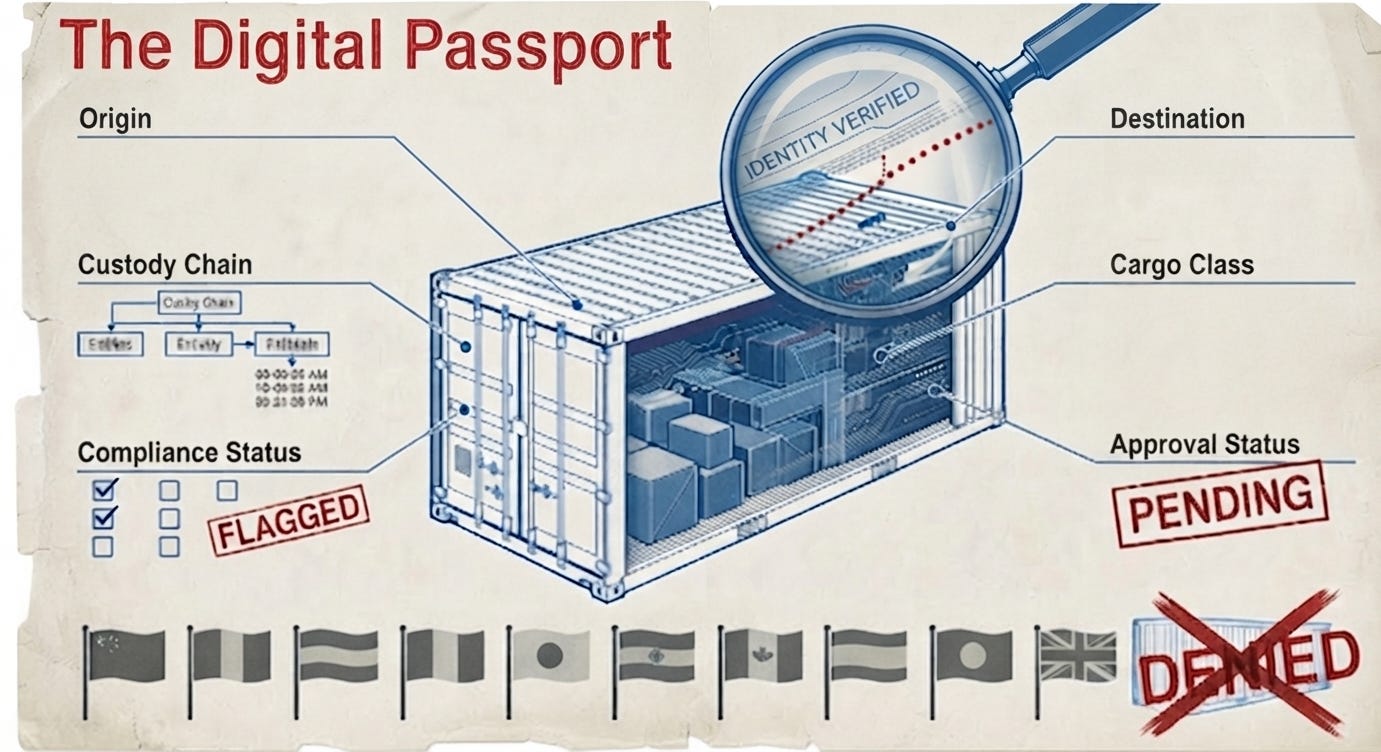
The digital passport is the operational heart of the Panama pilot. It is a cryptographic credentialing system for AI-related cargo—a verified digital record that travels with a shipment, certifying its origin, custody, and compliance status from the point of mineral extraction to the final destination. It is a log of every step in the chain.
The pilot itself is a twenty-four-month program the State Department commissioned in August 2026 for $50 million. Its first deployment is the Panama Canal—one of the most important shipping chokepoints on earth. The system must be designed and built from scratch.
Here is how it works. Every shipment of semiconductors, critical minerals, or AI infrastructure would be checked against that record. If verification confirms the cargo is from a trusted source and has followed approved routes, it gets pre-approved expedited processing and faster customs clearance. If the record shows a gap—an unapproved origin, a missing link in the chain—the shipment is held.
If the pilot succeeds, the platform expands to other Pax Silica countries. Every member economy would be plugged into the same verification system. Every shipment would be logged, credentialed, and either fast-tracked or held for inspection. The digital passport becomes the gatekeeper of the AI economy. Whoever controls the credential controls who gets to participate.
 Viconor Red Light Ther...
Buy New $59.99
(as of 02:12 UTC - Details)
Viconor Red Light Ther...
Buy New $59.99
(as of 02:12 UTC - Details)
This is what “economic security” means in practice. Not merely secure supply chains—controlled supply chains. And controlled supply chains are not a new kind of power. They are the oldest kind. Whoever controls access to exchange controls the people who must exchange. Revelation 13:17 says no one can buy or sell without the mark. The mark is not on the hand or the forehead. It is in the ledger needed for life.
Here is the inversion that makes the American position unique. Proverbs 22:7 says the borrower is the slave of the lender. By that logic, the United States—the world’s largest debtor—should be the slave. Instead, it built a system in which its creditors are trapped by its debt. If the US collapses, they collapse with it. The debtor became the master—not by escaping the debt, but by making the debt shared.
Pax Silica is the attempt to extend that inversion into the next century. It is what you might expect from the world’s largest debtor, searching for a new anchor before the old one fails. The world’s largest debtor is in charge the way a man at the edge of a cliff is in charge of the people roped to him. If he falls, they fall too. And they know it.
One system determines which physical goods can move. The other determines how economic transactions within the network are priced and settled. Together they raise the question of who controls access to the next economy.
The Token Dollar
The “token dollar” is the financial layer of the Pax Silica architecture. It is a proposed evolution of the U.S. dollar’s global role, designed for the AI era. The idea is simple: make the U.S. dollar the default currency for pricing and settling AI computation—the “tokens” that AI models process and generate.
The parallel to oil is direct. The petrodollar system, built from 1974, made the dollar the mandatory currency for oil transactions. Every country that wanted oil had to hold dollars. The token dollar proposes that in the AI age, compute becomes the new strategic commodity, and it should be priced and settled in dollars.
 AMVital Turmeric Body ...
Buy New $8.99
(as of 05:51 UTC - Details)
AMVital Turmeric Body ...
Buy New $8.99
(as of 05:51 UTC - Details)
Here is how the mechanism works. Every AI transaction, from a single query to a full model training run, is priced in dollars. The payment rails are dollar-pegged stablecoins—programmable digital tokens designed to maintain a one-to-one value with the US dollar. When global companies buy AI compute, they generate dollar revenue for US-linked firms. That revenue flows into the dollar-based financial system. The reserves backing the stablecoins are invested in US Treasuries. Every AI transaction, anywhere in the world, increases demand for US government debt.
The Center for Strategic and International Studies (CSIS), a Washington think tank closely tied to the national security establishment, recommends the US lead a coalition to make the dollar the “default unit of pricing for token generation,” using dollar-backed stablecoins to settle these contracts and connecting the system to US futures markets.
This is where the three layers close into a loop. The physical gate—the Panama pilot—controls which goods move. The credentialing layer—the digital passport—determines who is trusted. The financial layer—the token dollar—captures the value. A country that wants to participate must align with Pax Silica’s rules, open its books, verify its supply chains, and accept the credentialing framework. Once that infrastructure is in place, every AI transaction within the network is priced and settled in dollars.
The loop closes like this. Global companies buy AI compute. They generate dollar revenue for US firms. The reserves backing the stablecoins go into US Treasuries. Dollar demand is reinforced. The US can borrow more cheaply. It funds its deficits. It projects power. It maintains the system.
The data shows this is already happening. More than 98% of agent-to-agent settlements over the past year used USDC, a dollar-pegged stablecoin issued by Circle, a private company that holds US Treasuries as reserves.
Between May 2025 and April 2026, autonomous AI agents settled roughly $73 million across 176 million on-chain transactions — an average of about 31 cents per payment. Separately, stablecoins processed $33 trillion in total on-chain transaction volume in 2025, surpassing Visa and Mastercard combined. That figure includes trading and DeFi activity, not just commercial payments. The real-world commercial volume was smaller — about $400 billion — but it doubled year over year.
If it succeeds, the token dollar is the financial abstraction endgame: the U.S. dollar becomes the system’s entropy accelerator. It takes massive amounts of real energy and resources and disperses them into digital abstractions. What remains is a number on a ledger—a number that must be fed still more energy just to persist.
 OCuSOFT Retaine MGD Op...
Buy New $21.17
(as of 05:51 UTC - Details)
OCuSOFT Retaine MGD Op...
Buy New $21.17
(as of 05:51 UTC - Details)
If it fails, the US loses the ability to borrow cheaply, fund its deficits, and project power abroad.
The War That Isn’t
Pax Silica is being rolled out during a period of unprecedented geopolitical disorder. The United States has, by its own actions, been described as a rogue state by much of the world—it kidnapped Venezuela’s president in January 2026, and its president talks openly about seizing Canada and Greenland.
Why? What would explain this behavior?
If the United States were at war, it would make sense. War justifies extraordinary measures. War justifies the suspension of normal rules. War justifies the seizure of resources, the control of supply chains, the mobilization of allies.
But “the war that isn’t” is clandestine, and for a reason. A declared war would require public consent. A clandestine war requires only that the public not notice the alternative architecture on the other side.
BRICS—the bloc of Brazil, Russia, India, China, South Africa, and six newer members—has spent a decade building institutions designed to move trade outside the dollar system. The New Development Bank, headquartered in Shanghai, has $100 billion in authorized capital and ten member countries. Its mandate is to finance infrastructure in emerging markets without the conditionalities that come with IMF or World Bank lending.
Critically, it is expanding local-currency financing—raising funds in member currencies and lending them in the same currencies, avoiding dollar conversion entirely.
BRICS Pay is the payment layer—a network that links the member states’ own payment systems (Russia’s SPFS, China’s CIPS, India’s UPI) into a single interoperability layer. It lets countries settle trade in their own currencies without routing through SWIFT, the Western-dominated messaging system that underpins most global banking. It is in pilot and phased rollout, not yet operational for all members. But the direction is clear.
There is also the Unit—a settlement instrument composed of 40% physical gold and 60% member currencies. It entered prototype phase in December 2025.
 Spiritual Warfare Pray...
Buy New $9.99
(as of 06:12 UTC - Details)
Spiritual Warfare Pray...
Buy New $9.99
(as of 06:12 UTC - Details)
Here is what makes the BRICS model different from the American model. NDB loans are not debt into infinity. They are structured to be repaid. Loan tenures run from 10 to 30 years, with grace periods built in. They are increasingly denominated in local currencies, so borrowers repay in the currency they earn, not the currency they have to buy. And they come without the structural adjustment programs that the IMF and World Bank have used for decades—no forced austerity, no privatization requirements, no policy conditions that override national sovereignty.
This is the distinction that matters. The American system turns debt into a permanent asset. It rolls over. It expands. It requires continuous inflow. The BRICS system treats debt as a tool for development—borrow, build, repay, and then the infrastructure belongs to you.
Pax Silica is the mechanism by which the United States intends to maintain its position as the world’s hegemon in an era when the old foundations are failing. The BRICS system is the mechanism by which its rivals intend to route around it. Both are control architectures for the global economy—and neither is being debated as one.
The two systems are not at war with each other in any conventional sense. They are building parallel infrastructure. Pax Silica credentials goods. BRICS Pay settles payments. Pax Silica ties nations to the dollar. The NDB lends in local currencies to free them from it. Neither side is trying to destroy the other. Both are trying to make the other optional.
And the nations in the middle—India, the UAE, Kazakhstan—are discovering that optionality is leverage. They can belong to both systems. They can extract from both. They can refuse to choose, and no one can make them.
This is what the war actually is. Not a shooting war. Not a declared conflict. A slow, grinding competition to determine which infrastructure the next century will run on. Pax Silica is the American bid. BRICS is the alternative. And the middle powers are the prize.
 THORNE Magnesium Glyci...
Buy New $24.70
(as of 03:36 UTC - Details)
THORNE Magnesium Glyci...
Buy New $24.70
(as of 03:36 UTC - Details)
 Nature Made Magnesium ...
Buy New $11.11
(as of 02:57 UTC - Details)
Nature Made Magnesium ...
Buy New $11.11
(as of 02:57 UTC - Details)
 Physician’s CHOI...
Buy New $8.99
(as of 03:46 UTC - Details)
Physician’s CHOI...
Buy New $8.99
(as of 03:46 UTC - Details)
 Emergen-C Vitamin C 10...
Buy New $12.33
(as of 01:27 UTC - Details)
Emergen-C Vitamin C 10...
Buy New $12.33
(as of 01:27 UTC - Details)
Copyright © Wendy Williamson
 How Many Ministries of Truth Does One Country Need?