


A EURO-PACIFIC/PETER SCHIFF WHITE PAPER
by Thomas E. Woods, Jr. by Thomas E. Woods, Jr.
In 1920—21, the United States faced a grave economic crisis, worse than the first year of the Great Depression. Double-digit unemployment and a 21 percent decline in production over the previous twelve months greeted the new president.
That president, the now-despised Warren G. Harding, told Americans that the bust following the artificial, credit-induced boom of the war years had to be faced up to, and that no government, however wise, could make it disappear:
The economic mechanism is intricate and its parts interdependent, and has suffered the shocks and jars incident to abnormal demands, credit inflations, and price upheavals…. We must seek the readjustment with care and courage. Our people must give and take. Prices must reflect the receding fever of war activities…. All the penalties will not be light, nor evenly distributed. There is no way of making them so. There is no instant step from disorder to order. We must face a condition of grim reality, charge off our losses and start afresh. It is the oldest lesson of civilization…. Any wild experiment will only add to the confusion. Our best assurance lies in efficient administration of our proven system.
Government actually cut its budget during the crisis. There was no fiscal "stimulus." The Fed looked on passively. And by the summer, recovery had already begun. According to today’s textbooks, that wasn’t supposed to happen. But it did.
President Barack Obama’s approach to the present crisis couldn’t be more different. Once in office, the candidate who had run on "hope" began speaking in apocalyptic terms of what might happen to Americans if vigorous government intervention were not undertaken. At the very least, we might experience an extended slump rivaling the Great Depression. Just look at Japan, Obama said in his first press conference as president. Japan "did not act boldly and swiftly enough," he said, "and as a consequence they suffered what was called the u2018lost decade’ where essentially for the entire ’90s they did not see any significant economic growth."
As usual, unfortunately, our president draws the wrong lesson from history. Japan acted too "boldly" and "swiftly." Tens of trillions of yen in stimulus packages, combined with propping up failing companies, lowering interest rates to zero, and much additional intervention besides, had nothing to show for it other than making Japan the most indebted country in the developed world. Keynesians desperate to find some reason that their entire slate of proposals failed to elicit a response from the Japanese economy try to argue that Japan didn’t nationalize its banking sector fast enough. But when Japan did start nationalizing its banks, it then endured the two worst years (1998 and 1999) of the whole "lost decade."1
Shortly after taking office, President Obama urged the Congress to approve a "stimulus" package amounting to $787 billion in order to (he said) restore the economy to health. In his first news conference as president, Obama warned that a failure to pass this bill "could turn a crisis into a catastrophe." "I can tell you with complete confidence," he continued, "that a failure to act will only deepen this crisis as well as the pain felt by millions of Americans." (For the projected deficits resulting from Obama’s spending plans, see Fig. 1.)
Fig. 1  Source: Washington Post; CBO, White House Office of Management and Budget
But, fashionable superstitions notwithstanding, government spending — that is, draining resources from the productive sector and devoting them to arbitrary projects — cannot improve the economy. It can only make things worse. So blinded are Keynesian economists, from whom Obama takes his inspiration, by the view that prosperity is attributable to "spending" per se that they predicted a return to depression conditions when World War II spending came to an end. And indeed in 1946, the year after the war ended, the budget was cut by two thirds. But instead of reverting to depression, what occurred instead was the single most robust year the private economy has ever seen.2
What the economy really needs, contra Obama, is not government "stimulus" spending to try to revive it as it is. We should not want to "stimulate" what should now be obvious to everyone was an unsustainable economy. That only encourages it to continue along a false path whose inevitable abandonment in the future will be all the more painful thanks to our insistence on propping it up now. As we’ll see, what the economy instead needs is a market-driven restructuring, in which bubble activities shrink and resources are reallocated into lines of production that conform to what consumers want and can afford.
Where the Bust Came From
How, after all, did we get into this slump? The key culprit is the Federal Reserve and its loose monetary policy.3 The new money created by the Fed under Alan Greenspan in the years following 9/11 went overwhelmingly into the housing market, inflating prices to unheard-of levels (see Fig. 2). According to the faulty conventional wisdom that rapidly took hold, this rise in prices was a sustainable phenomenon that would persist into the future, not an artificial bubble destined to burst. The so-called experts told Americans that their homes were bound to appreciate, that a house was the best investment they could make, and that flipping houses was a sure money-making opportunity.
With home prices rising in tandem with people’s stock portfolios (another bubble), Americans felt wealthier than they really were. They made consumption decisions on the basis of those faulty estimates that they have since come to regret. Some business enterprises that began or expanded under the conditions of the boom could continue profitably only as long as the boom lasted and consumers’ artificially stimulated excess spending went on. With reality now reasserting itself — that is, with easy credit no longer so readily available, and with people now making their spending decisions in light of the decreased wealth they now realize they have — the market is trying to clear away these bubble activities, so that their resources can be made available for use by the real wealth generators in the economy.
Fig. 2  Source: Financial Wisdom, http://www.newfinancialwisdom.com/median-home-prices-inflation-adjusted; data from Robert J. Shiller, Irrational Exuberance
The market, in short, is trying to move consumers away from personal finance models based on indebtedness and too much (and/or the wrong kinds of) consumption, and toward more saving and a sustainable level of consumption. To accommodate this shift, labor and capital will need to be reallocated out of some sectors and into other ones. "Stimulus" spending only disrupts and confuses this purgative process, by misdirecting resources into arbitrary projects and artificially stimulating politically favored industries at the expense of the economy’s healthy and productive sector. Obama’s program for recovery, such as it is, looks instead to reinflate the bubble, keep the spending spree going, and give still more artificial stimulus to debt while providing disincentives to save. It refuses to allow the market to correct the unsustainable excesses in the economy. "No scheme which has ever been devised by them has ever made a collapsed boom go up again," said William Graham Sumner in 1896. Nothing in the historical record since then has altered that verdict.
The Federal Reserve, meanwhile, acting on the basis of the same economic principles laid out by the president, is likewise trying to repair the economy by engaging in more of what caused the problems in the first place. On March 18, 2009, the Federal Open Market Committee (FOMC) announced it would purchase up to $300 billion in long-term government bonds, with the intent of lowering mortgage rates and other rates on consumer debt. It also declared its intention to purchase up to $750 billion in mortgage-backed securities guaranteed by Fannie Mae and Freddie Mac. Instead of allowing the market to restructure along a sustainable path, the Fed instead seeks to keep home prices inflated, prop up the securitization model (on which the market is trying to render its negative verdict), and encourage more borrowing and debt.
"Stimulus" Spending Doesn’t Work — Or Make Sense
On a more basic level, the jobs that government creates are unprofitable — that is, they consume more resources than they produce. If that weren’t true, then the profit-seeking private sector would be funding them already. In fact, it’s impossible for government to know whether it is engaged in profitable, productive activity, since it lacks a profit-and-loss mechanism whereby it can calculate whether it is making efficient use of resources. "Stimulus" packages therefore drain the productive economy of resources in order to subsidize money-losing ventures. Because these money-losing ventures get resources shifted to them, fewer resources are available for use by the productive economy; and since the government sector uses resources less efficiently than the private sector, the net result is a decline in wealth — a fact no magical "multiplier" effect can overcome.
The more sophisticated Keynesians will come back with the argument that government stimulus can kick-start "idle resources" that weren’t being employed in any production process anyway. But how can it do that? Our idle resources include, for instance, some of our automobile production capacity, some construction capacity, some of our financial services sector, and the like, as well as a wide variety of types of labor. Now Obama’s stimulus package includes (for example) money to weatherize 2 million American homes. How can weatherizing homes put these and only these idle resources to work? It can’t, of course. And are there enough unemployed weatherizers to take these jobs, or will we be drawing labor from its current uses in the private sector? The question answers itself. In other words, the weatherizing job will have to draw from already employed factors of production, thus redirecting them to a less urgently demanded use than the one the market was already employing them for. That does not create "stimulus." It destroys value and wealth. And if the claim is that the money spent on weatherizing homes will eventually trickle down, somehow, to the unemployed workers in these other fields, it is hard to take such a crude mechanism seriously.
If we did happen to have enough unemployed weatherizers to weatherize people’s homes, then why would we need Obama’s stimulus package to force laborers and customers together? If prices were allowed to adjust freely, people wanting their homes weatherized would find the weatherizers on their own, and thus the effort to "stimulate" these transactions would become superfluous.
The Bailouts Continue
Barack Obama won the White House on a promise of "change we can believe in," but his approach to the economic crisis has been more of the same, including continued bailouts of failed institutions. As with so many other federal efforts, once the federal government spends a certain amount on a doomed enterprise, it feels compelled to continue the effort. We can’t stop now, the argument goes, since we’ve already "invested" $180 billion in AIG. That’s the bottomless pit that the bailout mentality, perpetuated by Obama, inevitably leads to. Instead of punishing every economic actor in America, Obama should let the losses from AIG fall on those who incurred them. If that means a string of bankruptcies, then so be it: after years of wild risks rewarded by bailouts, large institutions could stand a salutary reminder that ours is a profit and loss economy. With the foolish gamblers of AIG rebuked by the market and out of business, major market actors might think twice about taking unwise risks in the future. Only then would we lay the foundations for a sound, robust, and sustainable economy in the years to come.
On March 23, Treasury Secretary Timothy Geithner’s unveiled his proposal to assist the banks by taking "legacy assets" — the Newspeak term for toxic assets — off their books. Some 93 percent of the funding for this initiative would come from the taxpayer in one form or another. This kind of gimmick does not in fact make the losses associated with these assets magically disappear. It merely spreads out the losses, so that innocent and prudent third parties are made to share the bill with the foolish and reckless individuals whose poor decisions caused the problems. The hope is that shifting these assets onto the backs of the taxpayers will "unclog" the credit markets and get lending flowing once again. But the banks surely realize that Americans, by and large, have already borrowed more than they can pay back. Legacy assets or no legacy assets, the flow of credit is going to be allocated with greater prudence in the short run. (In the long run the lessons of the past will be forgotten — as they have been, without fail, throughout American history — and the reckless lending that the Fed’s easy money policy makes possible will start up once again.) What’s more, with various mortgage re-sets due to take place over the next couple years, the banks’ inventory of bad assets will continue to rise.
Simply recognizing the true values of previously mispriced assets leaves the amount of physical stuff in the economy unchanged. It could well lead to bankruptcies for some institutions, but that would mean only that the distribution of that unchanged amount of wealth would shift from one group of people to another group of people. Bankruptcy courts would establish new ownership, and economic activity could then resume on a new and sound foundation. There would be short-run pain, to be sure, but government policy can no more abolish pain than it can strike down the law of gravity.
Obama: "What I Won’t Do"
So now we know Obama’s intentions — for starters: spend, rely on the Fed to create lots of new money, and prop up failing companies. Now for what he won’t do.
"What I won’t do," the president said, "is return to the failed theories of the last eight years that got us into this fix in the first place, because those theories have been tested and they have failed."
What "theories" can the president have in mind? The past eight years saw massive increases in government spending, massive money creation by the Fed, and massive borrowing from abroad. Which one of those does the president plan to discontinue? Which one would he even slow down?
What Obama means, of course, is that the supposedly free-market policies of the past eight years have failed. The president is merely repeating the conventional wisdom, which holds that free-market economists have egg on their faces right now, with their cherished system crumbling before their eyes. The opposite is true. Which economists were most likely to have predicted the present fiasco? The free-market economists of the Austrian School, who warned that when the government’s central bank tampers with the market’s structure of interest rates, the result is systemic error on the part of businessmen, consumers, and investors. The faulty interest rates mislead investors into beginning projects that require more saved resources to complete than the economy actually has, and for whose ultimate products insufficient consumer demand exists. In the recent housing bubble, as we noted earlier, the Fed’s low interest rate policy, combined with government stimulus to homeownership, spawned an artificial boom in housing that made consumers think they were richer than they really were, thereby misleading them into making consumption decisions many have since come to regret.4
Economist Mark Thornton, who called the housing bubble back when the authorities denied the very possibility of a national bubble in real estate, uses three graphs (Figs. 3, 4, and 5) to tell the story. Figure 3 shows the fall in the federal funds target rate, Figure 4 shows the fall in mortgage rates, and Figure 5 shows the dramatic increase in real estate loans that resulted:
Fig. 3  Source: Mark Thornton, Ludwig von Mises Institute
Fig. 4 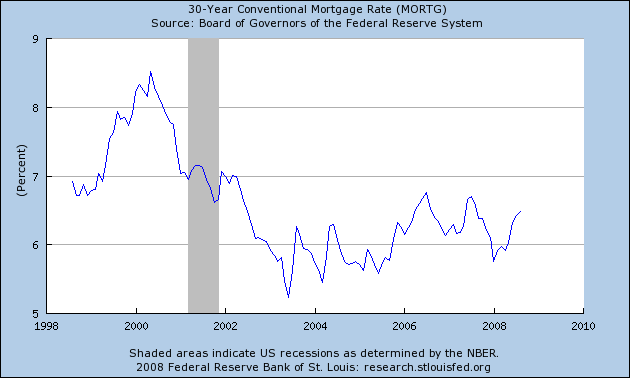 Source: Mark Thornton, Ludwig von Mises Institute
Fig. 5  Source: Mark Thornton, Ludwig von Mises Institute
Had the Fed not created all that new money (which is then multiplied through the fractional-reserve system), the market would have stopped the housing bubble in its tracks. Faced with an inordinate demand for mortgage loans, banks would have found their supply of loanable funds rapidly depleted. As a result, interest rates would have shot up, and further speculation in real estate would have been arrested. These high interest rates, it’s worth pointing out, would have encouraged people to save, and those increased savings would have provided the genuine wherewithal for any further home lending to take place. (Remember that old-fashioned idea that resources need to be saved by someone first before someone else can borrow them?)
To make matters worse, the economy of the past eight years operated under the implied promises of the "Greenspan put," which important market actors took to mean that there was a floor beneath which the Fed would not permit asset prices to fall. The Financial Times spoke in 2000, in the wake of the dot-com boom, of an increasing concern that the Greenspan put was injecting into the economy "a destructive tendency toward excessively risky investment supported by hopes that the Fed will help if things go bad." "Since Alan Greenspan took office," writes economist Antony Mueller, "financial markets in the U.S. have operated under a quasi-official charter, which says that the central bank will protect its major actors from the risk of bankruptcy. Consequently, the reasoning emerged that when you succeed, you will earn high profits and market share, and if you should fail, the authorities will save you anyway."
This is not exactly the free market at work. Neither are Fannie Mae and Freddie Mac, the Community Reinvestment Act, and the 101 other ways the federal government has poured fuel on our financial fire.
"Green Jobs"
Another well-known plank of the Obama economic plan involves the creation of "green jobs," which will employ Americans in lines of work related to climate change abatement and the transition from the use of fossil fuels to renewable energy sources. For the sake of argument, we’ll leave aside the scientific debate over climate change and the extent to which human activity influences it, and the scientific merit of the claims made on behalf of alternative forms of energy. What matters here is that supporters of the president’s plan argue that these artificially created jobs will be good for the economy; "progressive" think-tanks have produced studies purporting to show the wonderful effects the president’s initiative will have on employment and economic prosperity.
These studies, though, are filled with every economic fallacy in the book. The "green jobs" spoken of are treated as if they amount to a raw increase in the amount of employment in America, without acknowledging that (1) the people taking these jobs will often be leaving other ones behind, yielding no net increase in employment, and (2) the private sector will now have to compete with these government-subsidized jobs for scarce labor. The emphasis on green jobs is itself misplaced, since it suggests that the sheer number of jobs in a particular industry is something to cheer. From a purely economic point of view, it is not a sign of progress to move to a more labor-intensive energy industry, since doing so merely draws employment away from the production of other goods and makes society poorer: we’d have the same amount of energy, but less of other things.
Moreover, when the Council of Mayors estimates the growth in green jobs from 750,000 to 4.2 million in 2038, it overlooks the issue of labor productivity. If productivity growth continues at its average annual rate of 2 percent (an average observed from 1970 to the present), then the number of green jobs in 2038 is cut almost in half, to 2.3 million.5
Cornered by these facts, advocates of green jobs would doubtless retort that encouraging renewable energy sources — however hopeless a project it probably is — is an end in itself, regardless of its effects on employment. Even if that were true, the point is that these measures are being urged on us right now on economic grounds, which crumble at the slightest scrutiny.
What Should Be Done vs. What Will Be Done
For the sake of American prosperity, Obama should consider the one path the political establishment has not considered: allowing the free market to allocate capital and labor, to price assets, and to choose winners and losers. The recovery would be swift in coming, as it always is when the market is allowed to operate. And economic success would once again be the product of hard work and entrepreneurial skill, not cultivating political connections in Washington.
As usual, the politicians have other ideas: bail everyone out, try to reinflate the bubble, squander more resources on arbitrary projects, reward borrowing and debt, and create lots of new money. Every one of these measures props up bubble activities and undermines genuine wealth-generating activities. The bailouts allocate capital away from the prudent and competent and toward the imprudent and incompetent, from the wealth creators to the wealth destroyers. The "fiscal stimulus" fritters away scarce resources on money-losing (that is, value-destroying) projects. Making debt more attractive encourages more of the behavior that brought us to this unhappy impasse, thereby guaranteeing a worse bust in the future. Printing up new money does not magically create new real resources in the economy. It merely redistributes the existing pool of resources into a configuration that does not correspond to real consumer demand. It diverts resources into artificial activities with which genuinely wealth-generating activities are then forced to compete.
 In short, the president’s program aggravates every existing problem in the American economy, and will make genuine recovery all the longer in coming. Whether we measure these policies against history or sound economic theory, the verdict is the same: the president has chosen a path that is guaranteed to fail. We were already on that path before his election. Only if President Obama genuinely changes course, and allows the free economy to restore the prosperity that so much previous intervention served to undermine, would we really have change we can believe in.

