


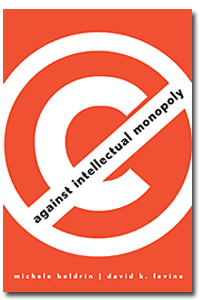
Well, I did my best but a wonderful book written decades ago which has since sunk without a trace and will not be resurrected in my lifetime and you will not read it, will not learn from it, and a chance for the immortalization of the ideas therein will not come to fruition.
This is because the “owner” of the IP — even though he is clueless about the social value of the book — cannot be persuaded to let it be published at a market price.
I’m trying to be sympathetic to a person (and person who clearly has not read Against Intellectual Monopoly) who would fail to give permission for a reprint of his grandfather’s book, and hence keep good literature out of circulation, possibly forever.
I’m trying to be sympathetic but it is hard.
Here is a scenario that helps you see how the state’s IP laws distort people’s judgment.
Let’s say I get a phonecall from the company “Simply Asia” and they inform me that my grandfather invented a unique noodle shape and that the patent on it passed to me in probate. Now, until this moment my life had been perfectly normal, flowing by day by day like every other life, but now I am aware of a long-hidden treasure in my family history.
What do I think? I think: $$$$
You might too.
You would want to know more about this company, how many noodles they expect to sell, how much money you are going to get per noodle, how big a house you will be able to buy, how fast your new Maserati will drive on the autobahn, and what date you can retire from your day job.
So it is. Not that you had anything to do with the stupid noodle design. It is an accident of fate that the patent happened to fall into your hands. But you don’t think about that fact. All you can think about is you newfound wealth. You are imagining a scene from the opening of the Beverly Hillbillies. Black gold, Texas tea.
Sadly, the company that wants to put the noodle in production informs me that they want to give me $500 and be done with it forever. I’m thinking: who do these people think they are? What a ripoff. My family’s noodle design is fantastically valuable! Maybe I will produce it myself and not let these robbers in on the deal. The gears in my wild imagination start turning and turning and turning.
However, it turns out that I really don’t know anything about the noodle market. I don’t know how to make them, package them, sell them, or anything else. A month or two goes by and I lose interest in the whole noodle thing. Having turned down the company, I’m no worse off than I was before. But I won’t call them back and take the $500 because, who knows? Maybe next year I can get into the whole noodle-making thing.
We know the end of the story. Nothing happens. The noodle stays out of production. The noodle company is sad but not devastated. There’s always another shape of noodle it can sell.
Sad to say, many of the books that will fail to be printed are great books. But they might as well have never been written. The author is in no position to protest because he or she is six feet in the ground. His or her legacy, about which the heir cares less than nothing, is buried too.
The problem is that within the structure of IP there is no rational way to price anything. The property is made scarce only by the state. Its scarcity is otherwise wholly artificial. The function of prices is to rationally allocate scarce goods but when goods are infinitely reproducible and made scarce only by the state, pricing too becomes akin to pricing under socialism. You just end up making things up in the face of radical information asymmetries.
If I were offering to buy this guy’s planter on his porch — a scarce good with replacement possibilities and involving real expenditure — he could make a rational price and I could decide to meet it or not. But when offering to buy someone’s IP, we are both completely blind as to the value. He imagines infinite value and hence price. I imagine small price. There are no objective considerations to resolve the differences in our outlooks.
 Now, what of the justice of this situation? There is no justice. The “heir” is a fake who, under a free market, would own no more than you or me. He would be in no position to keep a book published 30 years ago from coming back into print. He wouldn’t be owed one thin dime, and he would never know the difference anyway.
But under an interventionist system in which the state makes up this preposterous idea of “intellectual property rights” and arbitrarily assigns power to individuals to coerce others into failing to make profitable exchanges possible, enterprise is seriously hampered. Companies that want to print books can’t and people who want to buy them can’t do so. Society is made worse off.
There is a way out for the wise few who are on the receiving end of a call about one’s IP. Think of the greater good. Ideally you would be fair and wise and liberate the idea and give it back to the world to which it rightly belongs. If you aren’t that high-minded, fine, take the moderate amount and money and move on.
Whatever you do, don’t join the state, don’t join the book burners, pretend you business savvy is going to net you millions, or otherwise behave like a jerk. Have some respect for your family legacy and say yes to reprints. The state, through its IP laws, is bringing out the worst in most people. You can refuse to go along.
Jeffrey Tucker [send him mail] is editorial vice president of www.Mises.org.

