

by Chris Rossini Economic Policy Journal
Recently by Chris Rossini: The U.S. Has Perfected Good Cop / BadCop
There’s much more to the “date which will live in infamy” than the U.S. Dept. of Education would like to you know about.
Along with Lincoln, one of the most exalted Presidents in the land of the free is FDR. Is there a town in this country that doesn’t have a street named after either of them?
According to the Dept. of Education, FDR not only had the messianic task of saving all of us from the ravages of “capitalism”, but he had the added burden of dealing with a “surprise” attack from a bunch of crazy Japanese people.
It’s during those trying times that the greatness of an FDR is needed.
Give him three terms if necessary!
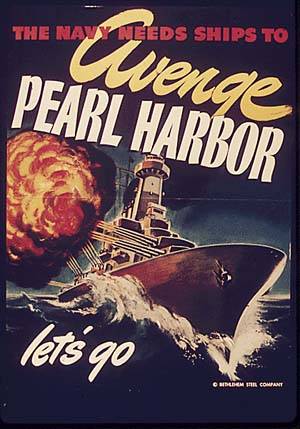 Let’s now close the schoolbooks, turn off PBS and The History Channel, and come back to reality.
Murray Rothbard, in his amazing work America’s Great Depression, crushed the first part of the fairy tale into a fine powder.
The Federal Reserve created the boom/bust of the 1920’s, and the Hoover/FDR tag team turned, what should have been a short downturn, into a tortuous and long “Great” one. Hoover got the ball rolling. He said: “We might have done nothing. That would have been utter ruin. Instead we met the situation with proposals to private business and to Congress of the most gigantic program of economic defense and counterattack ever involved in the history of the Republic.” FDR, then took over the grand experiment from the “laissez-faire” Hoover and…well, you know the rest.
The second part of the FDR fairy tale was recently addressed in a great talk given by Robert Higgs. I highly recommend that you listen to the whole thing, but I transcribed a few excerpts below.
Tuck them away for the next time that you’re debating a worshipper of one of America’s “Great” Presidents.
Here’s Robert Higgs:
Consider these summary statements by George Victor. And, by the way, George Victor is by no means a Roosevelt basher. It’s the other way around. He greatly admires Roosevelt and entirely approves of the actions Roosevelt took to bring the United States into the war. So that’s why I think he makes a good source for my purposes. You know he didn’t set out to provide grist for my mill.
He has a very nice book out called The Pearl Harbor Myth, which I believe is completely honest and well done in its documentation. I’m going to read a long excerpt from that book by George Victor: “Roosevelt had already lead the United States into war with Germany in the spring of 1941; into a shooting war on a small scale. From then on, he gradually increased U.S. military participation. Japan’s attack on December 7th enabled him to increase it further and to obtain a war declaration.
Pearl Harbor is more fully accounted for as the end of a long chain of events, with the U.S. contribution reflecting a strategy formulated after France fell in the spring of 1941. In the eyes of Roosevelt and his advisors, the measures taken early in 1941 justified a German declaration of war on the United States; a declaration that did not come, to their disappointment.
Roosevelt told his Ambassador to France, William Bullet, that U.S. entry into war with Germany was certain, but must wait for an incident, which he was confident the Germans would give us. Establishing a record in which the enemy fired the first shot was a theme that ran through Roosevelt’s tactics.
He seems, eventually to have concluded, correctly as it turned out, that Japan would be easier to provoke into a major attack on the United States than Germany would be.
The claim that Japan attacked the United States without provocation was typical rhetoric. It worked because the public did not know that the administration had expected Japan to respond with war; to anti-Japanese measures it had taken in July 1941. Expecting to lose a war with the United States, and lose it disastrously, Japan’s leaders had tried with growing desperation to negotiate. On this point, most historians had long agreed.
Meanwhile evidence has come out that Roosevelt and Hull persistently refused to negotiate. Japan offered compromises and concessions, which the United States countered with increasing demands. It was after learning of Japan’s decision to go to war with the United States, if the talks “break down” that Roosevelt decided to break them off.
According to Attorney General, Francis Biddle, Roosevelt said he hoped for an incident in the Pacific to bring the United States into the European war.” These facts, and numerous others that point in the same direction, are for the most part anything but new. Many of them have been available to the public since the 1940’s. As early as 1953, anyone might have read a collection of heavily documented essays on various aspects of U.S. foreign policy in the late 1930’s and early 1940’s, edited by Harry Elmer Barnes, that showed the numerous ways in which the U.S. government bore responsibility for the country’s eventual engagement in World War II. It showed, in short, that the Roosevelt administration wanted to get the country into the war and worked craftily, along various avenues, to ensure that sooner or later it would get in; preferably in a way that would unite public opinion behind the war, by making the United States appear to have been the victim of an aggressor’s unprovoked attack.
As Secretary of War, Henry Stimson, testified after the war: “We needed the Japanese to commit the first overt act.” At present, however, 70 years after these events. Probably not 1 American in 1,000; maybe not 1 in 10,000 has an inkling of any of this history. So effective has been the pro-Roosevelt, pro-American, pro-World War II faction, that in this country it has utterly dominated teaching and popular writing about U.S. engagement in the so-called “Good War”…
American leaders knew, among many other things, what Foreign Minister Toyota had communicated to Ambassador Nomura on July 31st. I read from that message: “Commercial and economic relations between Japan and third countries, led by England and the United States, are gradually becoming so horribly strained that we cannot endure it much longer. Consequently, our Empire, to save its very life, must take measures to secure the raw materials of the South Seas.”
This was a message U.S. leaders read as of the end of July 1941. They knew the position Japan was in perfectly well. Because American cryptographers had also broken the Japanese naval code, the leaders in Washington also knew that Japan’s measures would include an attack on Pearl Harbor. Yet, they withheld this critical information from the Commanders in Hawaii, who might have headed off the attack or prepared themselves better to defend against it. That Roosevelt and his chieftains did not ring the toxin, makes perfect sense. After all, the impending attack constituted precisely what they had been seeking for a long time.
As Stimson confided to his diary, after a meeting with the War Cabinet on November 25th 1941:
“The question was how we should maneuver them into firing the first shot without allowing too much danger to ourselves.” After the attack occurred, Stimson confessed that: “My first feeling was of relief, that a crisis had come in a way which would unite all our people.” 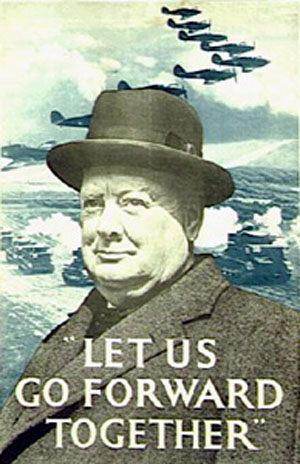 “It has been the policy of the cabinet at almost all cost to avoid embroilment with Japan until we were sure that the United States would also be engaged.” ~ Winston Churchill to The British House of Commons on Jan. 27, 1942
Reprinted with permission from Economic Policy Journal.

