What is peace? To me, peace is the set of beliefs held by voluntaryists. Peace is an open society, sharing ideas and living lives of individually-valued prosperity. Peace is a community built upon the principles of self-ownership, respect of property, and adherence to non-aggression. If that is peace, it may well be said that peace no longer exists.
Today peace is often defined with doublespeak language reflecting the dystopic predictions of a mid-aged George Orwell. It is perpetual war with an unknown enemy. It is "fighting them there so we don't have to fight them here". It is the molestation of innocent women and children by a security force sanctioned by the state and forcibly funded by the very people it abuses.
I have seen no politician speak the truth except Ron Paul. He has been extremely consistent in his view of a non-interventionist stance on foreign policy and its benefits to the United States, which continues to elude the other presidential candidates. I've seen many fellow political activists who truthfully promote a peaceful foreign policy yet plan on voting for Obama due to ignorance of the man's own agenda that is eerily similar to George Bush's. For everyone who truly believes that a world without war is possible, I hope this quick guide to Ron Paul's beliefs and actions will help you in deciding who you should vote for in the 2012 presidential election.
1997: Bosnia and Herzegovina
Beginning in April of 1992, 4,000 miles away from the United States, a centuries-old ethnic conflict regained momentum. An overwhelming majority of Croats and Bosnians decided to seek independence from the Socialist Federal Republic of Yugoslavia, but many other people had a different intention: maintaining loyalty to the federation and the Yugoslav People’s Army (YPA). In the same month, nearly 100,000 people showed up to a peace rally in Bosnia, a symbolic response to the events currently unfolding in the country. Unfortunately Serb snipers sitting in a nearby hotel had orders to obey. They opened fire on the activists rallying for peace, including a 23-year old innocent Bosnian medical student named Suada Dilberović, one of the first casualties of the conflict. For many people, the murder of Dilberović is considered to be the match that sparked the flames of the Bosnian War.
Even though the YPA decided to leave Bosnia in May of that year, Ratko Mladić, once a high-ranking Serb military leader and now accused war criminal, and other allies remained in their place in order to build up armed forces as part of a separatist movement. These actions led the Croats and Bosnians, fearing the portrayal of weakness, to create their own militaries. Everything escalated from there. And, even though tensions were high for participants, please take note: the US government's hand in the original break-up of Yugoslavia is still debated, but, when it came to the safety of US citizens, we had no reason to be there.
No realistic threat was made to our country. However, to paraphrase a certain White House Chief of Staff, letting a crisis go to waste is a threat to many of the corporatists currently scavenging through the US Treasury like vultures through a carcass. In the case of the Bosnian War, Ron Paul pointed out how many lobbyists were excited about the possibility of the invasion seeing as they were more likely to secure construction funding.
[A more recent example of government-business copulation is seen in the US government's partnership with Caterpillar, a company known for using its D9 armored bulldozers on behalf of the Israeli Defense Forces' demolition efforts in Palestine. Coincidentally, Caterpillar's greatest lobbying efforts within the past decade – nearly $3 million spent in 2007 alone – immediately preceded a notable year-long series of battles between Israelis and Palestinians. These things do happen.]
No matter how often the economically-illiterate New York Times columnist Paul Krugman tries to convince everyone that destruction (or at least fear of destruction) can lead to healthy growth in the economy, it only fills the wallets of the rich at the expense of both (1) taxpayers and (2) victims of the destruction whose houses now need re-building. Most military interventions survive the public conscience under the veil of foreign aid, but they usually have nothing to do with aiding anyone of importance. In Ron Paul's own words, "Why would an Air Force plane, with a dozen leading industrialists, be flying into a war-torn region like Bosnia, along with the Secretary of Commerce? I doubt they were on a humanitarian mission to feed the poor and house the homeless."
The congressman pointed out in 1997 – a year that marked a special visit to the US by the President of Bosnia and Herzegovina, Alija Izetbegović – that the troops, who were supposed to have left Bosnia nine months earlier, were still there, and it didn't look like they were headed towards their new exit goal of July 1998 either. In fact, two predictable military actions succeeded the US-led lift and strike policy during the 1995 bombing campaign when UN Resolution 836 opening unfounded "safe areas" to be guarded with force under Chapter VII of the UN Charter: (1) the Dayton Agreement sent for 16,500 US troops as part of the one-year Implementation Force, (2) and UN Resolution 1088 then sent about 3,900 US troops as part of the two-operation Stabilization Force, keeping US troops in Bosnia until December 2nd, 2004. Suffice it to say the congressman was correct is his predictions.
1998-1999: Iraq, part I
As Clinton rested his heavy finger on the violence button, it became even more apparent that the United States military was destined to bomb Iraq, not to protect the United States but to enforce various unrelated UN resolutions. When it came out that Russia had sold weapon technology to Iraq, Ron Paul stated the obvious, a clear fact already known to Congress: China had been doing the exact same thing for many years. Yet there was no talk about bombing either China or Russia. In fact, the US government had long given foreign aid to these two countries, meaning that Iraq's weapon technology – yes, the technology Clinton wanted to destroy – was most likely funded by the US government itself. Unfortunately the congressman's message remained unheard.
Only ten months later the US began its well-known bombing campaign in the Persian Gulf, an action Saddam Hussein knew would stir up anti-American sentiment in his own country, once again shifting the blame from his own dictatorial ways to the chaos enflamed by UN presence. As many prominent people, including Kuwaiti legislator Hassan Jawhar, explained, the US intervening in the domestic affairs of Iraq did nothing but strengthen the current Iraqi regime. Yet Clinton's administration continued risking even more US soldiers' lives in order to fund an operation which conclusively tightened Hussein's grasp on his own presidency.
And there Ron Paul stood the entire time, one of only ten dissenting Republican voices to H.R. 4655, the Iraq Liberation Act.
The civilian body count stacked up, and Ron Paul made the statement few people realized: "We have been bombing and occupying Iraq since 1991, longer than the occupation of Japan after World War II." Sometimes all it takes is a bit of historical comparison. Here we were occupying a country – that hadn't aggressed against the US – for a longer time than we occupied one of the Axis powers that (1) militarily struck the US in the attack on Pearl Harbor, and (2) was actually in an alliance with Nazi Germany and Fascist Italy. Did Iraq somehow pose more of a threat than an empire on which we felt the need to drop two nuclear bombs and kill upwards of 240,000 people during World War II (our last formal declaration of war), especially given the technological advancements in surveillance that have been created since the 1940s? No, I don't think so. This military action undertaken by President Clinton is only one more example of the many powers that have been passively given to presidents since the ratification of the US Constitution, an excess that has turned soldiers from heroes to pawns in the imperial game of policing the world.
2000: Colombia
The United States government has been involved in Colombia's civil war since its culmination in the 1960s, but it wasn't until the late 1990s and early 2000s with the proposition of Plan Colombia that the extent of US involvement became readily apparent in our own country. The reason for the intervention in the first place consisted of two main goals: (1) to suppress the left-wing insurgents, and (2) to eliminate drug trafficking – a little mixture I deem "Communist Cocaine". As Ron Paul spoke about the dozen South American leaders' rejections of US-backed military action in the area and the mission's irrelevance to our own national security, Clinton called for a two-year emergency aid package worth $1.3 billion to be sent to Colombia, turning the country into the world's third-largest recipient of US foreign aid, right behind Israel and Egypt.
As usual the casus belli changed dramatically from the original statement of Plan Columbia, one calling for assistance in a developmental peacemaking process, to a politically-incited counternarcotics invasion – in 2000, $765 million was sent to Colombia's military and police force alone, an astounding increase of over $450 million from the previous year. Meanwhile, as billions in taxpayer money were wasted, the guerrilla groups – FARC, ACCU, and the rest – were profiting immensely from selling the exact substances that the US government was trying to keep illegal. As Noam Chomsky noted in Rogue States: "The leader of the paramilitaries [Carlos Castaño] acknowledged last week in a television interview that the drug trade provided 70 percent of the group’s funding." Without enforcement of these prohibitions, the insurgents wouldn’t even have been able to continue their left-wing rebellions unless somehow funded by their own legal, productive means of work. We've seen time and time again that there's no point in fighting communism in foreign lands; the economic ideology sinks itself into scarcity in its rejection of the price system, and its communities never permanently exist without, in the words of Ludwig von Mises, "this most precious intellectual tool of acting." As the US government fuels its jets and packs its budgets with taxpayer money to be sent to Colombia to combat drugs, the left-wing insurgents it pretends to despise will fill their own wallets with the side-effects of the original intent. Few policymakers pointed out the obvious solution, but Ron Paul did – end the war on drugs, and we'll end the insurgents.
The congressman believes in peaceful principles for handling drug abuse in the United States, too. When people are participating in consensual, victimless activities, there is no point in using violence to cease the activities. Even ignoring the clearly detrimental effects of substance prohibition on the economy, the civil liberties of innocent people are being stomped on by the steel-toe boot of government. One quick example would be the 20-year old asthma patient who, after being pulled over in Texas with 14 grams of marijuana obtained in California at the recommendation of a physician, faced a life sentence. Other endless examples, in addition to the increasing occurrence of no-knock raids, exemplify a nation no longer governed by reason and ethics but ruled only by an emotion-based stream of rhetoric touted by career politicians for the purpose of gaining votes.
Every government prohibition – whether of drugs or guns or alcohol – rests on the false assumption that the State is effective in pursuing its goal. A vast amount of statistics has shown that there is no practical application of the viewpoint that drug abuse is an inherently aggressive activity. Decriminalization in Portugal led to an extremely low percentage of cannabis and cocaine prevalence in the country's general population in comparison to other members of the European Union (2001-2005), some of whose rates are double and triple that of Portugal; these facts are supplemented by a decrease in secondary effects of in drug addicts (i.e. HIV/AIDS). As Glenn Greenwald wrote, "By freeing its citizens from the fear of prosecution and imprisonment for drug usage, Portugal has dramatically improved its ability to encourage drug addicts to avail themselves of treatment." In that way, decriminalization is not a strategy for giving up on drug abuse; it's a practical approach for encouraging addicts to get treatment for an increasing problem in the community. This is a much different story than the tale of 20th century America. Jeffrey Miron and Jeffrey Zwiebel found that the later years of the Prohibition Era were met with 60-70 percent increased alcohol consumption, which, in addition to the rampant violence created by the black market's control over alcohol purchases, ended in events like the Saint Valentine's Day massacre. These terrible results explain the theory that most people already realize: there is no reason for the United States to have the highest incarceration rate in the entire world.
Once again, Ron Paul calls for an end to the unconstitutional war on drugs – an idea that can be seen in current legislation proposed by Paul and fellow congressman Barney Frank – and a presidential pardoning of nonviolent drug offenders.
2001-continued: The Middle East
Only three days after the tragic attacks on the morning of 9/11, Ron Paul stood tall, flags still at half-mast, to make a speech supporting congressional authorization of the use of force against the enemies who brought our nation to a standstill. A recollection of the week following the events brings to memory the sound of an outraged public whose only goal seemed to be to bring down the terrorists, no matter the cost. In that tailspin, it was Congressman Paul who made it his duty to place a grain of salt onto our anger-fueled desire for immediate revenge.
He stated, "[F]or us to pursue a war against our enemies, it's crucial to understand why we were attacked, which then will tell us by whom we were attacked. Without this knowledge, striking out at six or eight, or even ten different countries could well expand this war of which we wanted no part. Without defining the enemy, there is no way to know our precise goal or to know when the war is over. Inadvertent or casual acceptance of civilian deaths by us as part of this war, I'm certain, will prolong the agony and increase the chances of even more American casualties. We must guard against this if at all possible." It's a chilling prophesy, and a nearly perfect glimpse into what the future held for our country.
The reason "why we were attacked" to which the congressman is referring is the concept of blowback, a term used to describe the unintended consequences of military actions taken – secretly and openly – by the US government in foreign countries. Three examples include the CIA-orchestrated overthrow of Iran's democratically-elected Prime Minister, the US government's covert assistance to the Iraqi Army in the 1980s, and an astounding over-extension of US military presence throughout the world (i.e. over 600,000 buildings owned, personnel in over 150 countries). The notion that the US government causes hatred and backlash through its own "rational" actions is taboo to most people, one that the general population considers to be a radical idea; quite the contrary, though – the idea is a healthy plant sprung up from the seed of common sense. It is an acknowledgement of prominent members from both belligerents in the conflict.
The first is Michael Scheuer, an intelligence officer who worked as Chief of the CIA's Bin Laden Issue Station. He explained, "This war is dangerous to America because it’s based, not on gender equality, as Mr. Giuliani suggested, or any other kind of freedom, but simply because of what we do in the Islamic world – because ‘we're over there.'" The statement is much-needed, a nice refreshment from the ramblings of mass media spokespeople; what it isn't, however, is a statement of opinion – the words were given legitimacy by the enemy himself, Osama bin Laden, who recommended in a 2007 speech that people read Scheuer's book as a way of understanding the workings of Islamic militants. In fact, it was only three years earlier when bin Laden openly laid out the intentions of al-Qaeda in a speech directed to the American people: "[W]e, alongside the mujahidin, bled Russia for 10 years, until it went bankrupt and was forced to withdraw in defeat. […] So we are continuing this policy in bleeding America to the point of bankruptcy." As you can see, aside from these "revenge attacks", al-Qaeda has no intention to actively attack the United States. The organization's only tactic is to bait our government into fighting endless wars on behalf of an international foreign policy stance set up by the United Nations.
With everything said, it's important to get two things clear: (1) al-Qaeda, despite the US military's actions abroad, is not in any way the "good guy", and (2) Ron Paul is neither a pacifist nor an isolationist, two terms frequently misconstrued by his detractors.
Al-Qaeda may believe that its sponsored terrorist attacks are legitimate forms of self-defense to be praised by advocates of justice, but the message is completely erased when its suicide bombers strap explosives to their own bodies and ignite them in the middle of densely-populated cities. Everything is erased when they fly jets into the two tallest buildings in the United States and kill over 2,700 innocent people who had no say in their own government's actions when it came to war. Nonetheless, US intervention affects innocent bystanders living in the countries we invade. Their lives are filled with bombs being dropped from US military aircrafts and crop fields being set on fire with US-made chemicals. It's chaotic to them, and the anti-American sentiment grows within their minds little by little until they actually feel empathy with al-Qaeda. The military intervention does nothing but give these terrorists a platform from which to shout their fundamental misinterpretations of a peaceful religion.
As for pacification – pacifists are generally opposed to all kinds of violence, even acts of self-defense but especially initiations of physical force. Congressman Paul is opposed to the initiation of violence, but he realizes that, when an enemy of the US attacks innocent Americans for reasons that the victims are unable to change, it's important to strike back in retribution. When it comes to Ron Paul's stance on foreign policy, he promotes strong military defense, voting in support of the authorization for use of military force against the terrorists responsible for the September 11th attacks and then clarifying that "[w]e should guard against emotionally driven demands to kill many bystanders in an effort to liquidate our enemy."
The Founding Fathers would be ashamed of the current imperialistic military now employed by the US government, and their statements about the side effects of aggressive foreign policies were stated with emphasis in their time.
George Washington, in his farewell address, proclaimed, "The great rule of conduct for us in regard to foreign nations is in extending our commercial relations, to have with them as little political connection as possible." Thomas Jefferson echoed the sentiment a few years later in his first inaugural address: "Peace, commerce, and honest friendship with all nations, entangling alliances with none." It's evident that the Founding Fathers, much like Ron Paul, believe in the efficiency of the free market and open commerce with foreign nations; they decry the neoconservatives' own isolationist wishes – mainly the enactment of strict trading tariffs, the transfer of taxpayer money to US corporations, and the enforcement of legislation banning cultural differences.
Meanwhile the neoconservatives' foreign policy is the one currently being implemented with brute force, and we can see how that's turning out. The attacks on September 11th continue to be used as a cover for a war against nobody in general.
First the US government invaded an unrelated Iraq in 2003 to the dismay of Ron Paul, found zero weapons of mass destruction, and still hasn't left for one reason or another. Not only this, but the invasion created terrorists; as Robert Pape explains in Dying to Win, "Iraq never had a suicide attack in its history. Since our invasion, suicide terrorism has been escalating rapidly, with 20 attacks in 2003, 48 in 2004 and over 50 in just the first five months of 2005. Every year since the U.S. invasion, suicide terrorism has doubled."
Then the US government set up a puppet regime in Afghanistan under the lead of Hamid Karzai, enforced drug prohibition as terrorists freely floated around due to their wallets being filled with money made from selling opium – a result of the substance's senseless illegality – and now the once-"loyal" puppet is talking about joining the Taliban unless the UN stops barking orders.
And finally, an entire decade after the attacks on September 11th, we manage to find the one person we went after in the first place, Osama bin Laden… in Pakistan. Ron Paul said this in 2003. Let's take his exact words into account: "You know, there’s a border between Pakistan and Afghanistan. Pakistan’s on our side, Afghanistan is half and half. But right on that border is Osama bin Laden most likely. And he's probably in Pakistan."
We didn't need to lose thousands of American soldiers' lives. We didn't need to spend trillions of dollars. All we needed to do was listen to Ron Paul.
2010: WikiLeaks
On February 18, 2010, the world got its first taste of a new power, so to speak, not one based in the physical world but one that transcended theoretical transparence into the grid of the internet: WikiLeaks. The phrase began, "The things you say on the internet will stay there forever." The new phrase is a little different: "The classified diplomatic cables that leak onto the internet will get published in international newspapers through Julian Assange's whistleblower organization and will remain on mirror websites forever."
When the first cable was released in relation to Iceland's failing economy, it failed to garner a lot of media attention. However, the July and October releases of the Afghan War documents and the Iraq War documents, respectively, proved otherwise. The former was a grueling portrayal of the "underground aspects" of war, chiefly the employment of child prostitutes by Department of Defense contractors and the untold deaths of innocent civilians due to military mishaps; the latter is the largest intelligence leak in history, providing a further glimpse into the purposeful acts of violence in wartime such as executions by Iraqi soldiers and the murder of two Reuters employees due to an airstrike steered by US Apache helicopters.
The final leak that broke the US government's back occurred in November 2010 when 220 redacted cables were published by five main newspapers, eventually leading to the September 2011 release of all 251,287 unredacted cables. These cables revealed once-secret information about the international governmental sphere [and its well-connected, legislation-supported corporations]. To list only three of these extremely confusing details: (1) an attempt by Monsanto to retaliate against EU opposition to genetically-modified crops, (2) a strangely-affectionate analysis of the Prime Minister of Albania who seems almost too pleased to kiss the US government's feet, and (3) a refusal by the Vatican to cooperate in the inquiry into sexual abuse, a nearly perfect reminiscence of a conflict in Sin City.
I compare the last detail to a comic book series for a specific reason. The situations are so unbelievable that they almost seem to be the plots of fictional works by deluded authors. You'd think that in a logical and ethical world we'd see unanimous approval for such truths being brought out into the open for all to see; instead it's been an uphill battle for supporters of the action that exposed corruption in government. The beginning seemed like the flash of an intellectual revolution off the storyboards of V for Vendetta, only to end in the sad fashion of a mostly-apathetic youth being dragged down by detached patriots who will continue to support the government's actions under any evident circumstance.
 In the words of Julian Assange, "If journalism is good, it is controversial by its nature. It is the role of good journalism to take on powerful abuses, and, when powerful abuses are on taken on, there is always a back-reaction. We see that controversy, and we believe that it’s a good thing to engage in. In this case, they’ve all showed the true nature of this war."
When it came to the main subject of WikiLeaks' releases, the US government, none were too happy about it. Let's face it – government is never happy when intelligence information is leaked. You can see this predictable phenomenon at countless times in history, one recent example being the March 2010 subpoenaing of a New York Times writer in regards to a source of his book about CIA intelligence efforts to disrupt Iranian research into nuclear weapons.
The legal attempts to cease the existence of WikiLeaks were much more direct and threatening. First Representative Peter King ludicrously asserted that WikiLeaks, along with its founder Julian Assange, should be declared a foreign terrorist organization. Then Senator Joe Lieberman launched a campaign against companies that gave WikiLeaks access to their internet servers. Which purpose did all of these objections serve? Were they simply revenge against the exposition of secret actions the US government shouldn't have even been taking? It makes you wonder why certain people condemn the exposure of these actions while maintaining indifference towards the actions themselves.
It should come as no surprise by now that Ron Paul stood up proudly for the truth. Perhaps he put it in the most eloquent manner: "In a free society, we are supposed to know the truth. In a society where truth becomes treason, however, we are in big trouble. […] The neoconservative ethos, steeped in the teaching of Leo Strauss, cannot abide an America where individuals simply pursue their own happy, peaceful, prosperous lives. It cannot abide an America where society centers around family, religion, or civic and social institutions rather than an all powerful central state. There is always an enemy to slay, whether communist or terrorist. In the neoconservative vision, a constant state of alarm must be fostered among the people to keep them focused on something greater than themselves – namely their great protector, the state. This is why the neoconservative reaction to the WikiLeaks revelations is so predictable."
The ethical stance of the leaks will be disputed for years, if not decades, to come. Yet it still leaves the lurking question – if WikiLeaks can get our intelligence information, who else can get the information, and how easily? It would at least make a little bit of sense if the information were to have been somehow sneaked out of headquarters through one of the estimated 854,000 people who hold top-secret security clearances, but it wasn't even one of them. The access to the intelligence information was gained by an Army Private, a soldier of the lowest military rank. We're lucky that no classified "top secret" information was leaked to our enemies, at least that we know of. As Ron Paul asked, "Are we getting our money's worth from the $80 billion per year we spend on our intelligence agencies?" I certainly feel safe with the realization that we're capable of gaining this much intelligence in the first place, but it's extremely worrisome that the information is so mishandled by the bureaucracy involved in our ever-growing empire.
Let us embrace an open and well-educated country. There is no reason for our government to hold these secrets from us when we're paying for the inception of such inadequacies. To once again refer to a comic book – we now know that with great power comes great responsibility. It's beginning to become more and more obvious each year that the power held by the US government is turning into an irresponsible and dangerous catastrophe.
2011: Iran
It's difficult to pick out one single origin of the US government's conflicts with Iran. Most people point to the 1953 CIA-led coup d’état and subsequent installation of the Shah as the tipping point, but it's a long series of events leading up to the strained relations we now experience. Nonetheless, this year is the best time to discuss the topic because it will undoubtedly be brought up many times by warmongering politicians as a tactic to disenfranchise Ron Paul's presidential candidacy. Therefore we need to ask two questions: (1) why does Iran feel contempt towards the United States, and (2) is Iran really a threat to our country?
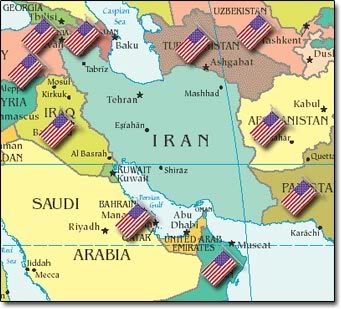
To answer the first question, it's important to review the previously-mentioned "long series of events" leading to the supposed contempt. Then, once you observe the current location of US military bases surrounding Iran, you begin to notice that the attitude of Iran doesn't seem so much about contempt as it does about fear. With the strongest military in the entire world encircling their country, the intimidation almost seems to be a move against their sovereignty.
The main political decisions have reflected similar preferences for imposing "indirectly-violent" sanctions in order to counter Iran's economic growth. Placing sanctions on a country is a government's interesting way of aggressing against the country without actually bombing it.
The US government set up sanctions against Bank Saderat Iran in 2006 for allegedly transferring money to terrorist organizations. One year later the state of Florida enacted a boycott of all companies investing in Iran or Sudan even if evidence lacked to prove deals with terrorist organizations, and this was followed by an expanded list of Iranian financial institutions that were to be cut off from the US financial system in general. Various other UN sanctions and Treasury orders have occurred throughout the rest of the decade in order to cease Iranian business, including last year's legislation signed by Obama which bans random Iranian exports to the US like pistachios and carpets. As explained in Obama's remarks before signing the recent legislation, the purpose of strict sanctions is to get a rise out of the unhappy Iranian citizens when their government fails to meet their needs due to international disobedience. However, this never happens; sanctions, by canceling out every alternative option for supply, create an even stronger dependence on the dictator, leading to starving masses and an uninformed population.
[For ease in discussing the effects of sanctions, we'll ignore the obvious fraud in the government handing out 10,000 special business licenses to well-connected corporatists who can now make deals in Iran without facing the consequence of competition.]
Take, for instance, the sanctions placed against Iraq in 1990 – they ended up killing hundreds of thousands of Iraqi children. And after all these deaths, the US government still felt it necessary to invade Iraq in 2003. It's not crazy to believe that the government has absolutely no limit in making foreign policy decisions despite the price of human life, especially after Madeleine Albright, US Ambassador to the UN at the time, stated in a 1996 interview with 60 Minutes that the children's deaths were worth it.
Let's pretend for a second that the number of Iranian deaths that would occur due to US-imposed sanctions would be 700,000. Many people will come back with the argument that, if the sanctions weren't imposed, Iran would collect and detonate a nuclear missile that could end up killing 700,000 Americans. In their case, you are deciding between the same number of deaths in two different countries, and, living in United States, I feel as if I can speak on behalf of most other Americans in saying that I would not like to die. It is a valid point assuming that you can tell the future. Alas, we cannot, but politicians are intent on making the American public feel as if they can.
Ron Paul mentioned this technique in a 2010 speech: "We hear war advocates today on the Floor scare-mongering about reports that in one year Iran will have missiles that can hit the United States. Where have we heard this bombast before? Anyone remember the claims that Iraqi drones were going to fly over the United States and attack us? These "drones" ended up being pure propaganda – the UN chief weapons inspector concluded in 2004 that there was no evidence that Saddam Hussein had ever developed unpiloted drones for use on enemy targets. […] We hear war advocates on the floor today arguing that we cannot afford to sit around and wait for Iran to detonate a nuclear weapon. Where have we heard this before? Anyone remember then-Secretary of State Condoleezza Rice’s oft-repeated quip about Iraq: that we cannot wait for the smoking gun to appear as a mushroom cloud."
This is when the second question comes into play: is Iran really a threat to our country? Taking the psychological approach may very well lead us to believe that sanctions on Iran may indeed increase the government's attachment to nuclear power in defense, a concept expanded upon by Jonathan M. Finegold Catalán. It really comes down to two simple facts: (1) the US nuclear force is outstandingly large, and (2) if Iran – or anyone else – were to shoot nuclear missiles at another country, the international community would immediately retaliate and wipe the country off of the entire planet within seconds of identifying the perpetrator for fear of a second attack. No one likes unpredictability and no one likes crazy people. This factor, in addition to its highly-nuclear Russian neighbors owning an even stronger nuclear force than the US, should truthfully be enough to convince most people that Iran is not a threat. We don't spend our days worrying about the Russians and the Chinese, and I see no reason to worry about the Iranians either. Somewhere around the development of our 1,700th operational strategic nuclear warhead I stopped feeling threatened by Iran.
The next argument made is that – although the Revolutionary Guards have only targeted US military bases in the Middle East and not our actual country itself – Mahmoud Ahmadinejad threatens Israel all of the time, and we need to protect Israel's interests.
First, we do not live in Israel. This is seemingly unknown to most US politicians who don't seem to understand the location of the US. It explains why Ron Paul wants to end foreign aid to countries in the Middle East and, you know, everywhere else we don't live.
Second, Ahmadinejad's speeches are notorious for being mistranslated and taken out of context in the process. This bandwagon fetish of repeating Ahmadinejad's "Israel needs to be wiped off the map" statement needs to be seriously reexamined by our leadership and the population in general. If Israel feels so much fear that it will be attacked by Iran, the country can make its own decisions about what to do without interference from the US and its international allies at the UN. After all, Israel is estimated to have around 300 nuclear weapons. I don't see how the rest of our collection will do their country any good.
We'll end in the words of Ron Paul: "The Iranians are a third-world nation. They don't have an army or a navy of any sort. They don't have inter-continental ballistic missiles. [A] country that has all that oil in their country – and they can't even produce enough gasoline and they have to depend on importing gasoline – and we're supposed to build up war fever and go to war over this? I don't think for a minute that, if they got those weapons, they would dare think about attacking Israel. Israel would take care of them, especially if they had no restraints from us. They would take care of them in minutes. It's not going to happen. It's all war propaganda."
2012: The Future of the United States
We can't allow ourselves to be pulled into perpetual warfare with indefinite enemies. It is a crucial time in our nation's history, and we can only go one of two ways. We have 10-year olds in the United States who know nothing but wartime. They do not understand peace. It's difficult to live with that idea in my mind. The idea that we can continue these wars while still being wealthy and free is a hollow utopia.
It's absolutely madness. And the dissenters are the ones who are deemed anti-patriotic? I love my country. I don't apologize for not letting it be whipped into submission at the hands of buffoons. They will verbally scold Ron Paul for being pro-peace because rhetoric is the last tool of men with no reason. They aren't putting on the uniforms, firing the guns, and risking their lives.
 Ron Paul supports the troops. He is the only candidate treating the troops as human beings. He is the only candidate treating their lives as sacred. Perhaps that's why he has received higher military donations than not only the current commander-in-chief but the rest of the other GOP candidates combined – over $36,000 through the end of August of this year. To give you a little comparison in terms of the other candidates, Ron Paul's closest GOP competitor was Herman Cain, who only received slightly more than $6,000.
Our soldiers are sending a very clear sign to the voters that they want to come home and be led by a man with real military intuition and a sound stance on foreign policy. Ron Paul will promote the same belief every time, just like he answered a veteran of the Iraq War who asked about the congressman's timetable to bring the troops home: "As soon as the ships can pick you up."
They continue wars without voting. They continue bombing campaigns without authorization. They continue taxation without representation. We have seen these actions in the annals of history, and we know what must be done. We need someone to do it. Ron Paul is that person. Let it not be said that we did nothing.
It does not have to be this way.