


Eating Fat Doesn’t Make You Fat
February 21, 2012
Recently by Joseph Mercola: Cancer Alert: Beware of These 5 Home Appliances
Story at-a-glance
- A wonderful infographic based on Why We Get Fat by science writer Gary Taubes, explains exactly why eating fat doesn't make you fat – but eating carbs can kill you
- Overeating carbohydrate-rich foods can prevent a higher percentage of fats from being used for energy, and lead to an increase in fat storage. It also raises your insulin levels, which in short order can cause insulin resistance, followed by diabetes and other chronic diseases.
- According to experts, carbs should make up only 20 percent of your diet, while 50-70 percent of your diet should be healthy fats.
- Fat is far more satiating than carbs, so if you have cut down on carbs and feel ravenous, this is a sign that you haven’t replaced them with sufficient amounts of healthy fat.
Even though the low-fat craze has ended and more people are embracing healthy fats in their diet, there’s still a sizable group that has not heard the news yet …
Eating fat will not make you fat as quickly as eating carbs will.
This, in a nutshell, is what you need to recognize if you’re struggling with your weight, as limiting non-vegetable carbs is crucial to weight loss.
If you’re having trouble getting your mind around this, a wonderful infographic created by Column Five for Massive Health, based on Why We Get Fat by science writer Gary Taubes, explains exactly why eating fat doesn’t make you fat – but eating carbs can kill you …
Carbs are Killing You and Making You Fat!
Today, I believe it’s safe to say that most people eat far too many carbs and not enough healthy fats with about 50% of the average American’s diet consumed as carbs.
Severely limiting grain carbs and sugars, while simultaneously increasing your fat consumption can be the U-turn you’ve been looking for if you are currently overweight and/or your health is suffering.
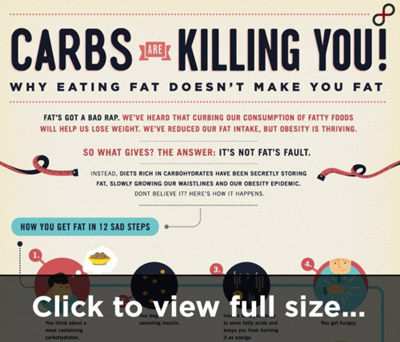 IMAGE COURTESY OF MASSIVE HEALTH. READ ABOUT THIS INFOGRAPHIC
But why?
The infographic above does a great job of simplifying an otherwise complex concept, specifically the role of dietary carbs in increasing insulin levels and weight gain/obesity. I highly recommend reviewing it now …
As explained, overconsumption of carbs is the primary driving factor for insulin resistance and type 2 diabetes. Unfortunately, the conventional medical wisdom has unwisely been extolling the virtues of carbohydrates for years, even placing them as the “foundation” of the highly flawed food pyramid.
If you are seeking to lose weight and optimize your health, foods like bread, rice and pasta should comprise very low percentages of your diet. Virtually anyone who bought into these high-carb, low-fat dietary recommendations has likely struggled with their weight and health, wondering what they’re doing wrong.
The problem is that overeating carbohydrates can prevent a higher percentage of fats from being used for energy, and lead to an increase in fat production and storage. It also raises your insulin levels, which in short order can cause insulin resistance, followed by diabetes. Insulin resistance is also at the heart of virtually every chronic disease known to modern man.
Your Body Stores Excess Carbs as Fat
Your body has a limited capacity to store excess carbohydrates. This is one of the reasons why elevated blood sugar follows their overconsumption. One of the ways your body avoids dangerously elevated blood sugar is through converting those excess carbohydrates into excess body fat primarily in your belly. The way it works is that any carbohydrates not immediately used by your body are stored in the form of glycogen (a long string of glucose molecules linked together). Your body has two storage sites for glycogen: your liver and your muscles. Once the glycogen levels are filled in both your liver and muscles, excess carbohydrates are converted into fat and stored in your adipose, that is, fatty, tissue.
So, although carbohydrates are “fat-free,” this is misleading because excess carbohydrates end up as excess fat. Puffed rice, in fact, is capable of making your blood sweeter than white sugar, due to the fact that it is higher on the glycemic index – all the more reason why refined grains are “hidden sugar,” and sugar is in many ways “hidden fat.”
But that’s not the worst of it. Any meal or snack high in carbohydrates will also generate a rapid rise in blood glucose. To adjust for this rapid rise, your pancreas secretes insulin into your bloodstream, which then lowers your levels of blood glucose. The problem is that insulin is essentially a storage hormone, evolved to put aside excess carbohydrate calories in the form of fat in case of future famine. So the insulin that’s stimulated by excess carbohydrates aggressively promotes the accumulation of body fat!
In other words, when you eat too much sugar, bread, pasta, and any other grain products, you’re essentially sending a hormonal message, via insulin, to your body that says “store more fat.” This is actually a highly beneficial response in certain scenarios such as when calories are very scarce. This provides a major survival advantage – but for nearly everyone reading this, having insufficient calories is not an issue, so this protective mechanism actually sabotages your health.
Additionally, increased insulin levels also:
- Make it virtually impossible for you to use your own stored body fat for energy.
- Suppress two important hormones: glucagon and growth hormone. Glucagon promotes the burning of fat and sugar. Growth hormone is used for muscle development and building new muscle mass.
- Increases hunger: As blood sugar increases following a carbohydrate meal, insulin rises with the eventual result of lower blood sugar. This results in hunger, often only a couple of hours (or less) after the meal, in a vicious endocrine rollercoaster that takes us from meal to compulsive meal without ever feeling satisfied.
So, all in all, the excess carbohydrates in your diet can not only make you fat, they can make sure you stay fat. Cravings, usually for sweets, are frequently part of this cycle, leading you to resort to snacking, often on more carbohydrates. Not eating can make you feel ravenous shaky, moody and ready to “crash.” If the problem is chronic, you never get rid of that extra stored fat, and your energy and overall health is adversely affected.
Realistically, How Many Carbs Can You Eat and Still be Healthy?
Dr. Ron Rosedale, the physician who first educated me about the importance of insulin, has used low-carb diets to treat his patients with obesity, diabetes and chronic diseases for over two decades. He argues that there is no such thing as a “safe” non-fiber starch (such as rice or potatoes).
Why?
He believes consuming starches, especially potatoes and rice, will disrupt both your blood sugar and insulin levels – the question is only a matter of to what degree? My guess is that from a biochemical perspective he is probably right, and if you need to lose weight, there is no question that limiting your sugar and starch intake is crucial. However, if living longer is not your primary objective and you are seeking to optimize fertility or athletic performance, then this most likely is not your best choice.
That said, I realize that giving up virtually all non-veggie carbs can be a challenge … so how many can you realistically eat and still be healthy?
According to Paul Jaminet, PhD. in his book Perfect Health Diet, a 20 percent carb diet is healthy for nearly everyone. He also believes that 50-70 percent of your diet should be healthy fat (healthy fats include not only monounsaturated fats like olive oil but also saturated fats, like those found in raw dairy products and grass-fed meat).
I keep very careful track of my diet with one of the best diet apps on the iPad (in my opinion) called Calorie Counter and Fitness Tracker. My guess is most people are not keeping such detailed records of what they eat. I typically have about 60% of my diet as healthy fat and about 25% of my total calories as carbohydrate. This amount is in line with Perfect Health Diet recommendations, but in my diet, most of the non-fiber carbohydrates are from veggies and about one cup of rice a day to help fill my glycogen stores that get depleted from my intense exercise regimen.
If you are already healthy, are seeking to maximize your longevity and take it to the next level, and are willing to experiment then give Dr. Rosedale’s suggestions a try by eliminating nearly all non-fiber carbs. This will be very challenging to implement in the beginning, but as your body grows accustomed and satiated from these extremely nutrient-dense low-carb foods, it should get much easier and will provide you outstanding health results that will be a continual source of encouragement.
A Word about Fructose (a Common Sugar in Soda, Fruit Juice and More) …
You will want to be very careful about the amount of fructose you consume as part of your carb intake, as it is by far the worst type of sugar there is in terms of both your health and your weight.
Fructose metabolism is quite different from glucose (dextrose) metabolism in that it places the entire burden on your liver, and this accounts for many of its devastating health effects. Furthermore, people consume fructose in enormous quantities these days, which has made the negative effects that much more profound. Without getting into the very complex biochemistry of carbohydrate metabolism, it is important to have a general understanding of how your body handles these sugars.
Below is a summary of the main differences between glucose and fructose metabolism, which explains why I keep repeating that fructose is by far the worst type of sugar there is:
- After eating fructose, virtually all of the metabolic burden rests on your liver. But with glucose, your liver has to break down only 20 percent.
- Every cell in your body, including your brain, utilizes glucose. Therefore, much of it is “burned up” immediately after you consume it. By contrast, fructose is turned into free fatty acids (FFAs), VLDL (the damaging form of cholesterol), and triglycerides, which get stored as fat.
- The fatty acids created during fructose metabolism accumulate as fat droplets in your liver and skeletal muscle tissues, causing insulin resistance and non-alcoholic fatty liver disease (NAFLD). Insulin resistance progresses to metabolic syndrome and type 2 diabetes.
- Fructose is the most lipophilic carbohydrate. In other words, fructose converts to activated glycerol (g-3-p), which is directly used to turn FFAs into triglycerides. The more g-3-p you have, the more fat you store. Glucose simply does not do this.
- When you eat 120 calories of glucose, less than one calorie is stored as fat. 120 calories of fructose results in 40 calories being stored as fat. Consuming fructose is essentially consuming fat!
- The metabolism of fructose by your liver creates a long list of waste products and toxins, including a large amount of uric acid, which drives up blood pressure and can cause gout.
- Glucose suppresses the hunger hormone ghrelin and causes resistance to leptin, which suppresses your appetite. Fructose has no effect on ghrelin and by interfering with your brain’s ability to use leptin, results in overeating.
If you want to shed excess pounds, maintain a healthy weight long-term, and RADICALLY reduce (and in many cases virtually eliminate) your risk of diabetes, heart disease and cancer, then get serious about restricting your consumption of fructose to no more than 25 grams per day, with a maximum of 15 grams a day from fresh fruit. If you’re already overweight, or have any of these diseases or are at high risk of any of them, then you’re probably better off cutting that down to 10-15 grams per day – fruit included.
If you believe you are an exception to this rule then you can measure your uric acid level. If it is below 5 when you are eating loads of fruit then you are metabolically ok with it, as elevated uric acid levels are a strong indication of fructose toxicity.
It’s Time to Let Go of Your Fear of Fat
When you cut carbs, you need to replace those calories with healthy fats. Both are sources of energy, but healthy fats are far more ideal than carbs. However, not just any kind of fat will do. The Atkins Diet is one popular example of a low-carb, high-fat diet that has helped many shed unwanted pounds. Unfortunately, Dr. Atkins didn’t pay much attention to the QUALITY of the fats, so while his recommendations worked in the short-term, many who tried it ended up experiencing long-term problems.
Many do not realize this, but frequent hunger may be a major clue that you’re not eating correctly. Not only is it an indication that you’re consuming the wrong types of food, but it’s also a sign that you’re likely consuming them in lopsided ratios for your individual biochemistry.
Fat is far more satiating than carbs, so if you have cut down on carbs and feel ravenous, thinking you “can’t do without the carbs,” remember this is a sign that you haven’t replaced them with sufficient amounts of fat. So go ahead and add a bit more healthy fats from the list below:
Olives and Olive oil Coconuts and coconut oil Butter made from raw grass-fed organic milk Raw nuts, such as, almonds or pecans Organic pastured egg yolks Avocados Grass-fed meats Palm oil Unheated organic nut oils
Another healthful fat you want to be mindful of is animal-based omega-3. Deficiency in this essential fat can cause or contribute to very serious health problems, both mental and physical, and may be a significant underlying factor of up to 96,000 premature deaths each year. As mentioned, emerging evidence actually suggests your diet should be at least half healthy fat, and possibly as high as 70 percent.
My personal diet is about 60-70 percent healthy fat, and both Drs. Jaminet and Rosedale agree that the ideal diet includes somewhere between 50-70 percent fat. It’s important to understand that your body requires saturated fats from animal and vegetable sources (such as meat, dairy, certain oils, and tropical plants like coconut) for optimal functioning, and if you neglect this important food group in favor of sugar, grains and other starchy carbs, your health and weight are almost guaranteed to suffer.
 Smacking Down the Warmongers