


 The Ethics of Liberty
Best Price: $9.63
Buy New $19.00
(as of 02:25 UTC - Details)
The Ethics of Liberty
Best Price: $9.63
Buy New $19.00
(as of 02:25 UTC - Details)

Here is the essential reading on anarcho-capitalism, which might also be called the natural order, private-property anarchy, ordered anarchy, radical capitalism, the private-law society, or society without a state. This is not intended to be a comprehensive list. Indeed, only English-language works currently in print or forthcoming are included. Please note that suggestions are welcome, especially for Section IV: Congenial Writings.
 For a New Liberty: The...
Best Price: $20.50
Buy New $66.60
(as of 07:15 UTC - Details)
For a New Liberty: The...
Best Price: $20.50
Buy New $66.60
(as of 07:15 UTC - Details)
I. Murray N. Rothbard and Austro-Libertarianism
At the top of any reading list on anarcho-capitalism must be the name Murray N. Rothbard. There would be no anarcho-capitalist movement to speak of without Rothbard. His work has inspired and defined the thinking even of such libertarians such as R. Nozick, for instance, who have significantly deviated from Rothbard, whether methodologically or substantively. Rothbard’s entire work is relevant to the subject of anarcho-capitalism, but centrally important are:
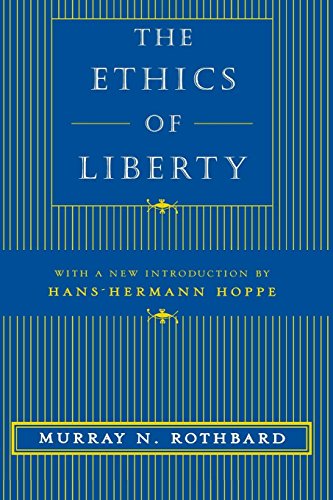
The Ethics of Liberty, the most comprehensive presentation and defense of a libertarian law code yet written. Grounded in the tradition of natural law and in its style of axiomatic-deductive reasoning, Rothbard explains the concepts of human rights, self-ownership, original appropriation, contract, aggression, and punishment. He demonstrates the moral unjustifiability of the state, and offers smashing refutations of prominent limited-statist libertarians such as L. v. Mises, F. A. Hayek, I. Berlin, and R. Nozick.
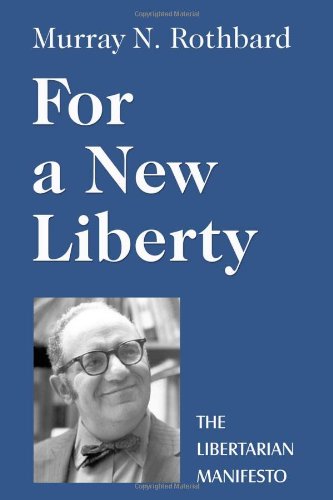
In For A New Liberty Rothbard applies abstract libertarian principles to solve current welfare-state problems. How would a stateless society provide for goods such as education, money, streets, police, courts, national defense, social security, environmental protection, etc.? Here are the answers.
 Egalitarianism as a Re...
Best Price: $3.44
Buy New $8.95
(as of 07:55 UTC - Details)
Egalitarianism as a Re...
Best Price: $3.44
Buy New $8.95
(as of 07:55 UTC - Details)
Power and Market is the most comprehensive theoretical analysis of the inefficiencies and counterproductive effects of every conceivable form of government interference with the market, from price controls, compulsory cartels, anti-trust laws, licenses, tariffs, child labor laws, patents, to any form of taxation (including Henry George’s proposed “single tax” on ground land).
 An Enemy of the State:...
Best Price: $11.27
Buy New $64.92
(as of 12:17 UTC - Details)
An Enemy of the State:...
Best Price: $11.27
Buy New $64.92
(as of 12:17 UTC - Details)
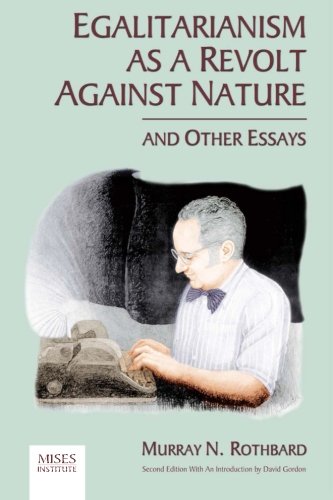
Egalitarianism As a Revolt Against Nature is a marvelous collection of Rothbard essays on philosophical, economic, and historical aspects of libertarianism, ranging from war and revolution to kids’ and women’s liberation. Rothbard shows his intellectual debt both to Ludwig von Mises and Austrian economics (praxeology) and to Lysander Spooner and Benjamin Tucker and individualist-anarchist political philosophy. This collection is the best single introduction to Rothbard and his libertarian research program.
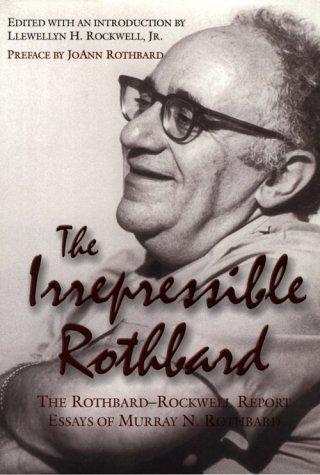
The four-volume Conceived in Liberty is a comprehensive narrative history of colonial America and the role of libertarian ideas and movements. Rothbard’s magisterial two-volume An Austrian Perspective on the History of Economic Thought traces the development of libertarian economic and philosophical thought throughout intellectual history. The Irrepressible Rothbard contains delightful libertarian commentary on political, social, and cultural issues, written during the last decade of Rothbard’s life.
Justin Raimondo has written an insightful biography: Murray N. Rothbard: An Enemy of the State.
The Austro-libertarian tradition inaugurated by Rothbard is continued by Hans-Hermann Hoppe. In Democracy — The God That Failed Hoppe compares monarchy favorably to democracy, but criticizes both as ethically and economically inefficient, and advocates a natural order with competitive security and insurance suppliers. He revises fundamental orthodox historical interpretations, and reconsiders central questions of libertarian strategy. The Economics and Ethics of Private Property includes Hoppe’s axiomatic defense of the principle of self-ownership and original appropriation: anyone arguing against these principles is involved in a performative or practical contradiction.
 The Irrepressible Roth...
Best Price: $9.72
Buy New $13.91
(as of 10:02 UTC - Details)
The Irrepressible Roth...
Best Price: $9.72
Buy New $13.91
(as of 10:02 UTC - Details)
The Myth of National Defense is a collection of essays by an international assembly of social scientists concerning the relationship between State and war and the possibility of non-statist property defense: by militias, mercenaries, guerrillas, protection-insurance agencies, etc.
 The Myth of National D...
Best Price: $2.50
Buy New $17.90
(as of 07:55 UTC - Details)
The Myth of National D...
Best Price: $2.50
Buy New $17.90
(as of 07:55 UTC - Details)
II. Alternative Approaches to Anarcho-Capitalism
The following authors come to similar conclusions but reach them in different ways and varying styles. While Rothbard and Hoppe are natural-rightsers of sorts and praxeologists, there exist also utilitarian, deontic, empiricist, historicist, positivist, and plain eclectic defenders of anarcho-capitalism.
Randy E. Barnett’s The Structure of Liberty is an outstanding discussion of the requirements of a liberal-libertarian society from the viewpoint of a lawyer and legal theorist. Heavily influenced by F.A. Hayek, Barnett uses the term “polycentric constitutional order” for anarcho-capitalism.
Bruce L. Benson’s The Enterprise of Law is the most comprehensive empirical-historical study of anarcho-capitalism. Benson provides abundant empirical evidence for the efficient operation of market-produced law and order. Benson’s sequel To Serve and Protect is likewise to be recommended.
David D. Friedman’s The Machinery of Freedom presents the utilitarian case for anarcho-capitalism: brief, easy to read, and with many applications from education to property protection.
Anthony de Jasay favors a deontic approach to ethics. His writing — in The State, in Choice, Contract, Consent, and the excellent essay collection Against Politics — is theoretical, with a neo-classical, game-theoretic flavor. Brilliant critic of public choice and constitutional economics — and the notion of minarchism.
 The Economics and Ethi...
Best Price: $42.48
Buy New $564.15
(as of 07:55 UTC - Details)
The Economics and Ethi...
Best Price: $42.48
Buy New $564.15
(as of 07:55 UTC - Details)
Morris and Linda Tannehill’s The Market for Liberty has a distinctly Randian flavor. However, the authors employ Ayn Rand’s pro-state argument in support of the opposite, anarchistic conclusion. Outstanding yet much neglected analysis of the operation of competing security producers (insurers, arbitrators, etc.).
 To Serve and Protect: ...
Best Price: $4.00
Buy New $68.22
(as of 10:55 UTC - Details)
To Serve and Protect: ...
Best Price: $4.00
Buy New $68.22
(as of 10:55 UTC - Details)
III. Precursors of Modern Anarcho-Capitalism
The contemporary anarcho-capitalist intellectual movement has a few outstanding 19th and early-20th century precursors. Even when sometimes deficient — the issue of ground land ownership in the tradition of Herbert Spencer and the theory of money and interest in the Spooner-Tucker tradition — the following titles remain indispensable and largely unsurpassed. (This listing is chronological and systematic, rather than alphabetical.)
Gustave de Molinari’s pathbreaking 1849 article The Production of Security is probably the single most important contribution to the modern theory of anarcho-capitalism. Molinari argues that monopoly is bad for consumers, and that this also holds in the case of a monopoly of protection. Demands competition in the area of security production as for every other line of production.
Herbert Spencer’s Social Statics is an outstanding philosophical discussion of natural rights in the tradition of John Locke. Spencer defends the right to ignore the state. Also highly recommended are his Principles of Ethics.
Auberon Herbert is a student of Spencer. In The Right and Wrong of Compulsion by the State, Herbert develops the Spencerian idea of equal freedom to its logically consistent anarcho-capitalist end. Herbert is the father of Voluntaryism.
 The Right and Wrong of...
Best Price: $3.38
Buy New $4.54
(as of 11:20 UTC - Details)
The Right and Wrong of...
Best Price: $3.38
Buy New $4.54
(as of 11:20 UTC - Details)
Lysander Spooner is a 19th-century American lawyer and legal theorist. No one who has read “No Treason,” included in The Lysander Spooner Reader, will ever see government with the same eyes. Spooner makes mincemeat of the idea of a social contract.
 Men Against The State:...
Buy New $24.95
(as of 02:50 UTC - Details)
Men Against The State:...
Buy New $24.95
(as of 02:50 UTC - Details)
A concise history of individualist-anarchist thought and the related movement in 19th-century America, with particular attention to Spooner and Benjamin Tucker, is James J. Martin’s Men Against the State.
Franz Oppenheimer is a left-anarchist German sociologist. In The State he distinguishes between the economic (peaceful and productive) and the political (coercive and parasitic) means of wealth acquisition, and explains the state as instrument of domination and exploitation.
Albert J. Nock is influenced by Franz Oppenheimer. In Our Enemy, the State he explains the anti-social, predatory nature of the state, and draws a sharp distinction between government as voluntarily acknowledged authority and the State. Nock in turn influenced Frank Chodorov, who would influence young Murray Rothbard. In his Fugitive Essays, a collection of pro-market, anti-state political and economic commentary, Chodorov attacks taxation as robbery.
IV. Congenial Writings
While not directly concerned with the subject of anarcho-capitalism and written by less-than-radical libertarian or even non-libertarian authors, the following are invaluable for a profound understanding of liberty, natural order, and the state.
 The Costs of War: Amer...
Best Price: $1.99
Buy New $13.46
(as of 08:00 UTC - Details)
The Costs of War: Amer...
Best Price: $1.99
Buy New $13.46
(as of 08:00 UTC - Details)
John V. Denson’s The Costs of War is a collection of essays by a distinguished group of libertarian and paleo-conservative scholars from various disciplines. Exposes the aggressive nature of the state. Possibly the most powerful anti-war book ever. Also to be recommended is Denson’s collection Reassessing the Presidency on the growth of state power.
David Gordon’s Secession, State, and Liberty is a collection of essays by contemporary philosophers, economists, and historians in defense of the right to secession.
 On Power
Best Price: $12.00
Buy New $12.95
(as of 03:30 UTC - Details)
On Power
Best Price: $12.00
Buy New $12.95
(as of 03:30 UTC - Details)
Friedrich A. Hayek, Law, Legislation, and Liberty, Vol. I, is an important study on the “spontaneous” evolution of law, and the distinction of law versus legislation and between private and public law.
Bertrand de Jouvenel, On Power, is an outstanding account of the growth of state power, with many important insights concerning the role of the aristocracy as defender of liberty and mass democracy as a promoter of state power. Related, and likewise to be recommended is his Sovereignty.
tienne de la Botie, The Politics of Obedience, is the classic 16th-century inquiry into the source of government power. La Botie shows that the state’s power rests exclusively on public “opinion.” By implication, every state can be made to crumble — instantly and without any violence — simply by virtue of a change in public opinion.
Bruno Leoni, Freedom and the Law, is an earlier and in some regards superior treatment of topics similar to those discussed by Hayek. Leoni portrays Roman law as something discovered by independent judges rather than enacted or legislated by central authority — and thus akin to English common law.
 The Politics Of Obedie...
Best Price: $11.94
Buy New $15.95
(as of 02:20 UTC - Details)
The Politics Of Obedie...
Best Price: $11.94
Buy New $15.95
(as of 02:20 UTC - Details)
Robert Nisbet, The Quest for Community (formerly published under the more descriptive title Community and Power) explains the protective function of intermediate social institutions, and the tendency of the state to weaken and destroy these institutions in order to gain total control over the isolated individual.
The Journal of Libertarian Studies. An Interdisciplinary Quarterly Review, founded by Murray N. Rothbard and now edited by Hans-Hermann Hoppe, is an indispensable resource for any serious student of anarcho-capitalism and libertarian scholarship.
 Our Enemy, the State
Best Price: $5.90
(as of 01:45 UTC - Details)
Our Enemy, the State
Best Price: $5.90
(as of 01:45 UTC - Details)
The following JLS articles are most directly concerned with anarcho-capitalism.
Anderson, Terry, and P.J. Hill, The American Experiment in Anarcho-Capitalism, 3, 1.
Barnett, Randy E., Whither Anarchy? Has Robert Nozick Justified the State?, 1,1.
——, Toward a Theory of Legal Naturalism, 2, 2.
Benson, Bruce L., Enforcement of Private Property Rights in Primitive Societies, 9,1.
—–, Customary Law with Private Means of Resolving Disputes and Dispensing Justice, 9,2.
—–, Reciprocal Exchange as the Basis for Recognition of Law, 10, 1.
—–, Restitution in Theory and Practice, 12, 1.
 Fugitive Essays: Selec...
Best Price: $1.48
Buy New $13.00
(as of 06:20 UTC - Details)
Fugitive Essays: Selec...
Best Price: $1.48
Buy New $13.00
(as of 06:20 UTC - Details)
Block, Walter, Free Market Transportation: Denationalizing the Roads, 3, 2.
—–, Hayek’s Road to Serfdom, 12, 2.
Childs, Roy A. Jr., The Invisible Hand Strikes Back, 1,1.
Cuzan, Alfred G., Do We Ever Really Get Out Of Anarchy?, 3, 2.
Davidson, James D., Note on Anarchy, State, and Utopia, 1, 4.
Eshelman, Larry, Might versus Right, 12, 1.
Evers, Williamson M., Toward a Reformulation of the Law of Contracts, 1, 1.
——, The Law of Omissions and Neglect of Children, 2, 1.
Ferrara, Peter J., Retribution and Restitution: A Synthesis, 6, 2.
Fielding, Karl T., The Role of Personal Justice in Anarcho-Capitalism, 2, 3.
Grinder, Walter E., and John Hagel, III, Toward a Theory of State Capitalism, 1, 1.
Hart, David M., Gustave de Molinari and the Anti-Statist Liberal Tradition, 3 parts, 5, 3 to 6, 1.
Hoppe, Hans-Hermann, Fallacies of Public Goods Theory and the Production of Security, 9, 1.
——, Marxist and Austrian Class Analysis, 9, 2.
——, The Private Production of Defense, 14, 1.
 Secession, State, and ...
Best Price: $25.31
Buy New $40.30
(as of 10:15 UTC - Details)
Secession, State, and ...
Best Price: $25.31
Buy New $40.30
(as of 10:15 UTC - Details)
Kinsella, N. Stephan, Punishment and Proportionality, 12, 1.
——, New Rationalist Directions in Libertarian Rights Theory, 12, 2.
——, Inalienability and Punishment, 14, 1.
Liggio, Leonard P., Charles Dunoyer and French Classical Liberalism, 1, 3.
Mack, Eric, Voluntaryism: The Political Thought of Auberon Herbert, 2, 4.
McElroy, Wendy, The Culture of Individualist Anarchism in Late 19th-Century America, 5, 3.
McGee, Robert W., Secession Reconsidered, 11, 1.
Osterfeld, David, Internal Inconsistencies in Arguments for Government: Nozick, Rand, Hospers, 4, 3.
——, Anarchism and the Public Goods Issue: Law, Courts, and the Police, 9, 1.
Paul, Jeffrey, Nozick, Anarchism, and Procedural Rights, 1, 4.
Peden, Joseph R., Property Rights in Celtic Irish Law, 1, 2.
 The Quest for Communit...
Best Price: $8.88
Buy New $13.00
(as of 08:20 UTC - Details)
The Quest for Communit...
Best Price: $8.88
Buy New $13.00
(as of 08:20 UTC - Details)
Peterson, Steven A., Moral Development and Critiques of Anarchism, 8, 2.
Raico, Ralph, Classical Liberal Exploitation Theory, 1, 3.
Rothbard, Murray N., Robert Nozick and the Immaculate Conception of the State, 1, 1.
——, Concepts of the Role of Intellectuals in Social Change Toward Laissez Faire, 9, 2.
——, Nations by Consent: Decomposing the Nation-State, 11, 1.
Sanders, John T., The Free Market Model versus Government: A Reply to Nozick, 1, 1.
Smith, George H., Justice Entrepreneurship in a Free Market, 3, 4 (with comments by Steven Strasnick, Robert Formani and Randy Barnett and a reply by Smith, in the same issue).
Sneed, John D., Order without Law: Where will Anarchists Keep the Madmen?, 1, 2.
Stringham, Edward, Market Chosen Law, 14, 1.
Tinsley, Patrick, Private Police: A Note, 14,1.
Watner, Carl, The Proprietary Theory of Justice in the Libertarian Tradition, 6, 3—4.

