Recently by Tom Engelhardt: Lessons From Lost Wars in 2012
These days, with a crisis atmosphere growing in the Persian Gulf, a little history lesson about the U.S. and Iran might be just what the doctor ordered. Here, then, are a few high- (or low-) lights from their relationship over the last half-century-plus:
Summer 1953: The CIA and British intelligence hatch a plot for a coup that overthrows a democratically elected government in Iran intent on nationalizing that country's oil industry. In its place, they put an autocrat, the young Shah of Iran, and his soon-to-be feared secret police. He runs the country as his repressive fiefdom for a quarter-century, becoming Washington's "bulwark" in the Persian Gulf – until overthrown in 1979 by a home-grown revolutionary movement, which ushers in the rule of Ayatollah Khomeini and the mullahs. While Khomeini & Co. were hardly Washington's men, thanks to that 1953 coup they were, in a sense, its own political offspring. In other words, the fatal decision to overthrow a popular democratic government shaped the Iranian world Washington now loathes, and even then oil was at the bottom of things.
1967: Under the U.S. "Atoms for Peace" program, started in the 1950s by President Dwight D. Eisenhower, the Shah is allowed to buy a 5-megawatt, light-water type research reactor for Tehran (which – call it irony – is still playing a role in the dispute over the Iranian nuclear program). Defense Department officials did worry at the time that the Shah might use the "peaceful atom" as a basis for a future weapons program or that nuclear materials might fall into the wrong hands. "An aggressive successor to the Shah," went a 1974 Pentagon memo, "might consider nuclear weapons the final item needed to establish Iran's complete military dominance of the region." But that didn't stop them from aiding and abetting the creation of an Iranian nuclear program.
The Shah, like his Islamic successors, argued that such a program was Iran’s national "right" and dreamed of a country that would get significant portions of its electricity from a string of nuclear plants. As a 1970s ad by a group of American power companies put the matter: "The Shah of Iran is sitting on top of one of the largest reservoirs of oil in the world. Yet he's building two nuclear plants and planning two more to provide electricity for his country. He knows the oil is running out – and time with it." In other words, the U.S. nuclear program was the genesis for the Iranian one that Washington now so despises.
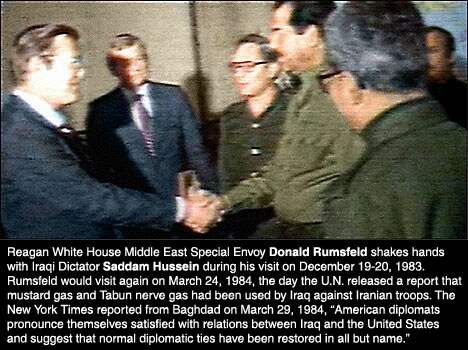
September 1980: Iraqi ruler Saddam Hussein launches a war of aggression against Ayatollah Khomeini's Iran. In the early 1980s, he becomes Washington's man, our "bulwark" in the Persian Gulf, and we offer him our hand – and also “detailed information” on Iranian deployments and tactical planning that help him use his chemical weapons more effectively against the Iranian military. Oh, and just to make sure things turn out really, really well, the Reagan administration also decides to sell missiles and other arms to Ayatollah Khomeini's Iran on the sly, part of what became known as the "Iran-Contra Affair" and which almost brings down the president and his men. Success!
March 2003: Saddam Hussein is, by now, no longer our man in Baghdad but a new "Hitler" who, top Washington officials claim, undoubtedly has a nuclear weapons program that could someday leave mushroom clouds rising over U.S. cities. So the Bush administration launches a war of aggression against Iraq, which like Iran just happens to – in the words of Deputy Secretary of Defense Paul Wolfowitz – "float on a sea of oil." (Bush officials hope, in the wake of a "cakewalk" of a war to revive that country's oil industry, to privatize it, and use it to destroy OPEC, driving down the price of oil on world markets.) Nine years later, a Shiite government is in power in Baghdad closely allied with Tehran, which has gained regional strength and influence thanks to the disastrous U.S. occupation.
So call it an unblemished record of a kind not easy to find. In more than 50 years, America's leaders have never made a move in Iran (or near it) that didn't lead to unexpected and unpleasant blowback. Now, another administration in Washington, after years of what can only be called a covert war against Iran, is preparing yet another set of clever maneuvers – this time sanctions against Iran's central bank meant to cripple the country's oil industry and crack open the economy followed by no one knows what.
And honestly, I mean, really, given past history, what could possibly go wrong? Regime change in Iran? It's bound to be a slam dunk and if you don't believe it, check out Pepe Escobar, that fabulous peripatetic reporter for Asia Times and TomDispatch regular. ~ Tom
The Myth of "Isolated" Iran: Following the Money in the Iran Crisis By Pepe Escobar
Let’s start with red lines. Here it is, Washington's ultimate red line, straight from the lion's mouth. Only last week Secretary of Defense Leon Panetta said of the Iranians, "Are they trying to develop a nuclear weapon? No. But we know that they’re trying to develop a nuclear capability. And that’s what concerns us. And our red line to Iran is do not develop a nuclear weapon. That’s a red line for us."
How strange, the way those red lines continue to retreat. Once upon a time, the red line for Washington was "enrichment" of uranium. Now, it's evidently an actual nuclear weapon that can be brandished. Keep in mind that, since 2005, Iranian Supreme Leader Ayatollah Khamenei has stressed that his country is not seeking to build a nuclear weapon. The most recent National Intelligence Estimate on Iran from the U.S. Intelligence Community has similarly stressed that Iran is not, in fact, developing a nuclear weapon (as opposed to the breakout capacity to build one someday).
What if, however, there is no "red line," but something completely different? Call it the petrodollar line.
Banking on Sanctions?
Let's start here: In December 2011, impervious to dire consequences for the global economy, the U.S. Congress – under all the usual pressures from the Israel lobby (not that it needs them) – foisted a mandatory sanctions package on the Obama administration (100 to 0 in the Senate and with only 12 "no" votes in the House). Starting in June, the U.S. will have to sanction any third-country banks and companies dealing with Iran's Central Bank, which is meant to cripple that country's oil sales. (Congress did allow for some "exemptions.")
The ultimate target? Regime change – what else? – in Tehran. The proverbial anonymous U.S. official admitted as much in the Washington Post, and that paper printed the comment. ("The goal of the U.S. and other sanctions against Iran is regime collapse, a senior U.S. intelligence official said, offering the clearest indication yet that the Obama administration is at least as intent on unseating Iran's government as it is on engaging with it.") But oops! The newspaper then had to revise the passage to eliminate that embarrassingly on-target quote. Undoubtedly, this "red line" came too close to the truth for comfort.
Former chairman of the Joint Chiefs of Staff Admiral Mike Mullen believed that only a monster shock-and-awe-style event, totally humiliating the leadership in Tehran, would lead to genuine regime change – and he was hardly alone. Advocates of actions ranging from air strikes to invasion (whether by the U.S., Israel, or some combination of the two) have been legion in neocon Washington. (See, for instance, the Brookings Institution's 2009 report Which Path to Persia.)
Yet anyone remotely familiar with Iran knows that such an attack would rally the population behind Khamenei and the Revolutionary Guards. In those circumstances, the deep aversion of many Iranians to the military dictatorship of the mullahtariat would matter little.
Besides, even the Iranian opposition supports a peaceful nuclear program. It's a matter of national pride.
Iranian intellectuals, far more familiar with Persian smoke and mirrors than ideologues in Washington, totally debunk any war scenarios. They stress that the Tehran regime, adept in the arts of Persian shadow play, has no intention of provoking an attack that could lead to its obliteration. On their part, whether correctly or not, Tehran strategists assume that Washington will prove unable to launch yet one more war in the Greater Middle East, especially one that could lead to staggering collateral damage for the world economy.
In the meantime, Washington's expectations that a harsh sanctions regime might make the Iranians give ground, if not go down, may prove to be a chimera. Washington spin has been focused on the supposedly disastrous mega-devaluation of the Iranian currency, the rial, in the face of the new sanctions. Unfortunately for the fans of Iranian economic collapse, Professor Djavad Salehi-Isfahani has laid out in elaborate detail the long-term nature of this process, which Iranian economists have more than welcomed. After all, it will boost Iran's non-oil exports and help local industry in competition with cheap Chinese imports. In sum: a devalued rial stands a reasonable chance of actually reducing unemployment in Iran.
More Connected Than Google
Though few in the U.S. have noticed, Iran is not exactly "isolated," though Washington might wish it. Pakistani Prime Minister Yusuf Gilani has become a frequent flyer to Tehran. And he's a Johnny-come-lately compared to Russia's national security chief Nikolai Patrushev, who only recently warned the Israelis not to push the U.S. to attack Iran. Add in as well U.S. ally and Afghan President Hamid Karzai. At a Loya Jirga (grand council) in late 2011, in front of 2,000 tribal leaders, he stressed that Kabul was planning to get even closer to Tehran.
On that crucial Eurasian chessboard, Pipelineistan, the Iran-Pakistan (IP) natural gas pipeline – much to Washington's distress – is now a go. Pakistan badly needs energy and its leadership has clearly decided that it's unwilling to wait forever and a day for Washington's eternal pet project – the Turkmenistan-Afghanistan-Pakistan-India (TAPI) pipeline – to traverse Talibanistan.
Even Turkish Foreign Minister Ahmet Davutoglu recently visited Tehran, though his country's relationship with Iran has grown ever edgier. After all, energy overrules threats in the region. NATO member Turkey is already involved in covert ops in Syria, allied with hardcore fundamentalist Sunnis in Iraq, and – in a remarkable volte-face in the wake of the Arab Spring(s) – has traded in an Ankara-Tehran-Damascus axis for an Ankara-Riyadh-Doha one. It is even planning on hosting components of Washington's long-planned missile defense system, targeted at Iran.
All this from a country with a Davutoglu-coined foreign policy of "zero problems with our neighbors." Still, the needs of Pipelineistan do set the heart racing. Turkey is desperate for access to Iran's energy resources, and if Iranian natural gas ever reaches Western Europe – something the Europeans are desperately eager for – Turkey will be the privileged transit country. Turkey's leaders have already signaled their rejection of further U.S. sanctions against Iranian oil.
And speaking of connections, last week there was that spectacular diplomatic coup de théâtre, Iranian President Mahmoud Ahmadinejad's Latin American tour. U.S. right-wingers may harp on a Tehran-Caracas axis of evil – supposedly promoting "terror" across Latin America as a springboard for future attacks on the northern superpower – but back in real life, another kind of truth lurks. All these years later, Washington is still unable to digest the idea that it has lost control over, or even influence in, those two regional powers over which it once exercised unmitigated imperial hegemony.
Add to this the wall of mistrust that has only solidified since the 1979 Islamic revolution in Iran. Mix in a new, mostly sovereign Latin America pushing for integration not only via leftwing governments in Venezuela, Bolivia, and Ecuador but through regional powers Brazil and Argentina. Stir and you get photo ops like Ahmadinejad and Venezuelan President Hugo Chavez saluting Nicaraguan President Daniel Ortega.
Washington continues to push a vision of a world from which Iran has been radically disconnected. State Department spokesperson Victoria Nuland is typical in saying recently, "Iran can remain in international isolation." As it happens, though, she needs to get her facts straight.
"Isolated" Iran has $4 billion in joint projects with Venezuela including, crucially, a bank (as with Ecuador, it has dozens of planned projects from building power plants to, once again, banking). That has led the Israel-first crowd in Washington to vociferously demand that sanctions be slapped on Venezuela. Only problem: how would the U.S. pay for its crucial Venezuelan oil imports then?
Much was made in the U.S. press of the fact that Ahmadinejad did not visit Brazil on this jaunt through Latin America, but diplomatically Tehran and Brasilia remain in sync. When it comes to the nuclear dossier in particular, Brazil's history leaves its leaders sympathetic. After all, that country developed – and then dropped – a nuclear weapons program. In May 2010, Brazil and Turkey brokered a uranium-swap agreement for Iran that might have cleared the decks on the U.S.-Iranian nuclear imbroglio. It was, however, immediately sabotaged by Washington. A key member of the BRICS, the club of top emerging economies, Brasilia is completely opposed to the U.S. sanctions/embargo strategy.
So Iran may be "isolated" from the United States and Western Europe, but from the BRICS to NAM (the 120 member countries of the Non-Aligned Movement), it has the majority of the global South on its side. And then, of course, there are those staunch Washington allies, Japan and South Korea, now pleading for exemptions from the coming boycott/embargo of Iran's Central Bank.
No wonder, because these unilateral U.S. sanctions are also aimed at Asia. After all, China, India, Japan, and South Korea, together, buy no less than 62% of Iran's oil exports.
With trademark Asian politesse, Japan's Finance Minister Jun Azumi let Treasury Secretary Timothy Geithner know just what a problem Washington is creating for Tokyo, which relies on Iran for 10% of its oil needs. It is pledging to at least modestly "reduce" that share "as soon as possible" in order to get a Washington exemption from those sanctions, but don't hold your breath. South Korea has already announced that it will buy 10% of its oil needs from Iran in 2012.
Silk Road Redux
Most important of all, "isolated" Iran happens to be a supreme matter of national security for China, which has already rejected the latest Washington sanctions without a blink. Westerners seem to forget that the Middle Kingdom and Persia have been doing business for almost two millennia. (Does "Silk Road" ring a bell?)
The Chinese have already clinched a juicy deal for the development of Iran's largest oil field, Yadavaran. There's also the matter of the delivery of Caspian Sea oil from Iran through a pipeline stretching from Kazakhstan to Western China. In fact, Iran already supplies no less than 15% of China's oil and natural gas. It is now more crucial to China, energy-wise, than the House of Saud is to the U.S., which imports 11% of its oil from Saudi Arabia.
In fact, China may be the true winner from Washington's new sanctions, because it is likely to get its oil and gas at a lower price as the Iranians grow ever more dependent on the China market. At this moment, in fact, the two countries are in the middle of a complex negotiation on the pricing of Iranian oil, and the Chinese have actually been ratcheting up the pressure by slightly cutting back on energy purchases. But all this should be concluded by March, at least two months before the latest round of U.S. sanctions go into effect, according to experts in Beijing. In the end, the Chinese will certainly buy much more Iranian gas than oil, but Iran will still remain its third biggest oil supplier, right after Saudi Arabia and Angola.
As for other effects of the new sanctions on China, don't count on them. Chinese businesses in Iran are building cars, fiber optics networks, and expanding the Tehran subway. Two-way trade is at $30 billion now and expected to hit $50 billion in 2015. Chinese businesses will find a way around the banking problems the new sanctions impose.
Russia is, of course, another key supporter of "isolated" Iran. It has opposed stronger sanctions either via the U.N. or through the Washington-approved package that targets Iran's Central Bank. In fact, it favors a rollback of the existing U.N. sanctions and has also been at work on an alternative plan that could, at least theoretically, lead to a face-saving nuclear deal for everyone.
On the nuclear front, Tehran has expressed a willingness to compromise with Washington along the lines of the plan Brazil and Turkey suggested and Washington deep-sixed in 2010. Since it is now so much clearer that, for Washington – certainly for Congress – the nuclear issue is secondary to regime change, any new negotiations are bound to prove excruciatingly painful.
This is especially true now that the leaders of the European Union have managed to remove themselves from a future negotiating table by shooting themselves in their Ferragamo-clad feet. In typical fashion, they have meekly followed Washington's lead in implementing an Iranian oil embargo. As a senior EU official told National Iranian American Council President Trita Parsi, and as EU diplomats have assured me in no uncertain terms, they fear this might prove to be the last step short of outright war.
Meanwhile, a team of International Atomic Energy Agency inspectors has just visited Iran. The IAEA is supervising all things nuclear in Iran, including its new uranium-enrichment plant at Fordow, near the holy city of Qom, with full production starting in June. The IAEA is positive: no bomb-making is involved. Nonetheless, Washington (and the Israelis) continue to act as though it's only a matter of time – and not much of it at that.
Follow the Money
That Iranian isolation theme only gets weaker when one learns that the country is dumping the dollar in its trade with Russia for rials and rubles – a similar move to ones already made in its trade with China and Japan. As for India, an economic powerhouse in the neighborhood, its leaders also refuse to stop buying Iranian oil, a trade that, in the long run, is similarly unlikely to be conducted in dollars. India is already using the yuan with China, as Russia and China have been trading in rubles and yuan for more than a year, as Japan and China are promoting direct trading in yen and yuan. As for Iran and China, all new trade and joint investments will be settled in yuan and rial.
Translation, if any was needed: in the near future, with the Europeans out of the mix, virtually none of Iran's oil will be traded in dollars.
Moreover, three BRICS members (Russia, India, and China) allied with Iran are major holders (and producers) of gold. Their complex trade ties won't be affected by the whims of a U.S. Congress. In fact, when the developing world looks at the profound crisis in the Atlanticist West, what they see is massive U.S. debt, the Fed printing money as if there's no tomorrow, lots of "quantitative easing," and of course the Eurozone shaking to its very foundations.
Follow the money. Leave aside, for the moment, the new sanctions on Iran's Central Bank that will go into effect months from now, ignore Iranian threats to close the Strait of Hormuz (especially unlikely given that it's the main way Iran gets its own oil to market), and perhaps one key reason the crisis in the Persian Gulf is mounting involves this move to torpedo the petrodollar as the all-purpose currency of exchange.
It's been spearheaded by Iran and it's bound to translate into an anxious Washington, facing down not only a regional power, but its major strategic competitors China and Russia. No wonder all those carriers are heading for the Persian Gulf right now, though it's the strangest of showdowns – a case of military power being deployed against economic power.
In this context, it's worth remembering that in September 2000 Saddam Hussein abandoned the petrodollar as the currency of payment for Iraq's oil, and moved to the euro. In March 2003, Iraq was invaded and the inevitable regime change occurred. Libya's Muammar Gaddafi proposed a gold dinar both as Africa's common currency and as the currency of payment for his country's energy resources. Another intervention and another regime change followed.
Washington/NATO/Tel Aviv, however, offers a different narrative. Iran's "threats" are at the heart of the present crisis, even if these are, in fact, that country's reaction to non-stop US/Israeli covert war and now, of course, economic war as well. It's those "threats," so the story goes, that are leading to rising oil prices and so fueling the current recession, rather than Wall Street's casino capitalism or massive U.S. and European debts. The cream of the 1% has nothing against high oil prices, not as long as Iran's around to be the fall guy for popular anger.
As energy expert Michael Klare pointed out recently, we are now in a new geo-energy era certain to be extremely turbulent in the Persian Gulf and elsewhere. But consider 2012 the start-up year as well for a possibly massive defection from the dollar as the global currency of choice. As perception is indeed reality, imagine the real world – mostly the global South – doing the necessary math and, little by little, beginning to do business in their own currencies and investing ever less of any surplus in U.S. Treasury bonds.
Of course, the U.S. can always count on the Gulf Cooperation Council (GCC) – Saudi Arabia, Qatar, Oman, Bahrain, Kuwait and the United Arab Emirates – which I prefer to call the Gulf Counterrevolution Club (just look at their performances during the Arab Spring). For all practical geopolitical purposes, the Gulf monarchies are a U.S. satrapy. Their decades-old promise to use only the petrodollar translates into them being an appendage of Pentagon power projection across the Middle East. Centcom, after all, is based in Qatar; the U.S. Fifth Fleet is stationed in Bahrain. In fact, in the immensely energy-wealthy lands that we could label Greater Pipelineistan – and that the Pentagon used to call “the arc of instability” – extending through Iran all the way to Central Asia, the GCC remains key to a dwindling sense of U.S. hegemony.
 If this were an economic rewrite of Edgar Allan Poe's story, "The Pit and the Pendulum," Iran would be but one cog in an infernal machine slowly shredding the dollar as the world's reserve currency. Still, it's the cog that Washington is now focused on. They have regime change on the brain. All that's needed is a spark to start the fire (in – one hastens to add – all sorts of directions that are bound to catch Washington off guard).
Remember Operation Northwoods, that 1962 plan drafted by the Joint Chiefs of Staff to stage terror operations in the U.S. and blame them on Fidel Castro's Cuba. (President Kennedy shot the idea down.) Or recall the Gulf of Tonkin incident in 1964, used by President Lyndon Johnson as a justification for widening the Vietnam War. The U.S. accused North Vietnamese torpedo boats of unprovoked attacks on U.S. ships. Later, it became clear that one of the attacks had never even happened and the president had lied about it.
It's not at all far-fetched to imagine hardcore Full-Spectrum-Dominance practitioners inside the Pentagon riding a false-flag incident in the Persian Gulf to an attack on Iran (or simply using it to pressure Tehran into a fatal miscalculation). Consider as well the new U.S. military strategy just unveiled by President Obama in which the focus of Washington's attention is to move from two failed ground wars in the Greater Middle East to the Pacific (and so to China). Iran happens to be right in the middle, in Southwest Asia, with all that oil heading toward an energy-hungry modern Middle Kingdom over waters guarded by the U.S. Navy.
So yes, this larger-than-life psychodrama we call "Iran" may turn out to be as much about China and the U.S. dollar as it is about the politics of the Persian Gulf or Iran's nonexistent bomb. The question is: What rough beast, its hour come round at last, slouches towards Beijing to be born?