


 Ek aur ek guyazah
A Hindi saying, meaning "1 + 1 = 11"
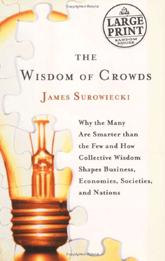
When we picked up James Surowiecki’s new book, The Wisdom of Crowds, we not only expected to be appalled; we counted on it. It is much easier to write a review of a man’s errors than it is to praise his merits. Beyond that, we had reason to expect little. We have come to believe that crowds are full of dumbbells and psychopaths; it would be a nuisance to alter such a strongly held opinion at this stage in life. What’s more, we felt that the book would probably provide encouragement to communists.
No one takes Bolshevism seriously any more. But unseriously, comically, almost accidentally, it has taken over most of the world — including the United States. The cost of paying retirements has been collectivized. Health care has been largely collectivized — both by government force and by the insurance industry. Risks of all sorts — including financial risk — have been spread out so much, no one knows exactly how far they reach. If a man defaults on his mortgage in San Diego, who will be the ultimate loser? It is hard to know. Risk is collectivized. And modern corporations are hardly the exploiters and despoilers of Marxist imagination. Au contraire, public companies are now owned by "the people" — through millions of small shareholdings and mutual funds. And they are managed in such a way that almost guarantees that the capitalists will never make money. Dividend yields are below 2% — while the inflation rate is 3.3%. Investors take on the dividend…even though it represents (assuming the share price remains constant) a net annual loss of 1.3%. The capitalists no longer exploit the proletariat, in other words. Instead, the workers exploit the little capitalists.
As evidence for this, we give you the latest report from GM. The giant automaker and finance house needs cash. "Liquidity is oxygen to us," said its CEO. Yet the cost of cash is going up. GM’s bonds are getting marked down to trade at junk levels after the company failed to hit earnings targets, says the news, because its health care costs [for employees] were higher than expected. GM, of course, is a huge collectivity: Owned by American consumers-turned-capitalists. Operated for the benefit of workers-turned-renters. And financed by lenders who are beginning to regret it.
There is another reason, by the way, we were prepared to dislike Surowiecki’s book. The man had written a foolish column in The New Yorker about gold. Not that that disqualifies him completely from future contributions to mankind’s understanding of the world around him, but it was a bad omen.
"Large groups of people are smarter than an elite few, no matter how brilliant — better at solving problems, fostering innovation, coming to wise decisions, even predicting the future," says the jacket cover. Did a large group of people write Shakespeare’s sonnets, we wondered? Did a large group of people invent the beret…or crispy duck? Will a large group of people help us fix our dishwasher?
It was, of course, a large group of people who wanted Adolf Hitler in the Chancellor’s office in Berlin. Another large group wanted to see Mussolini in high office. And what about the multitude of yahoos who cried out "crucify him!" when asked what to do with the Nazarene?
(We guessed that Surowiecki did not mean "crowds" at all — but aggregated, independent individuals, putting their heads together like Strunk and White.)
But now that we have read half the book we breathe a sigh of regret; the book is not bad. In fact, it is delightfully misleading.
The idea of the book is that crowds are smart. We never doubted it. "Two heads are better than one," is the old expression. Actually, two heads are often better than two. Putting people together with different points of views, different tastes, different brains, and different incentives actually can work a kind of magic — multiplying the talents of the people involved. Surowiecki provides many examples. We have our own: Laurel and Hardy. Rogers and Hammerstein. Gilbert and Sullivan. Bogart and Bacall. Simon and Garfunckel. Antony and Cleopatra. Brad and Jennifer. Lennon and McCarthy. Burns and Allen. Dow and Jones. Ernest and Julio. Jagger and Richards. Scrooge and Marley. Bonnie and Clyde. Jack and Daniels.
Ek aur ek guyazah.
Of course, this does not mean that every time you get a couple of knuckleheads together they’re going to write good music or build an atomic bomb. Get any bunch of people you want. We will bet that we will be better at guessing our PIN code — alone — than all of them put together. Nor can even a hundred of the smartest men on the planet do a better job of telling us what we want for breakfast than we can do for ourselves. Nor do you get any extra benefit from having a group of yes-men sitting around the table. Instead of giving you better outcomes, they merely reinforce the moronic ideas of the group leader. Even in decent groups, people tend to get bullied or bamboozled. Or, they merely follow along with any idea that has the floor. This sets off a "cascade" of ideas and opinions that tumbles toward an outcome — either benign or malevolent.
Still, the Bolsheviks and syndicalists were right about one thing: Collectives work. But the collectivists always make a mess of things when they insist. The only collectives that work are voluntary collectives — families, markets, communities, social groups, religious groups, enterprises — the very things the collectivists wanted to destroy.
 None of this is particularly new. Adam Smith, Adam Ferguson…and generations of natural philosophers and economists have worked on these issues for many years. What is refreshing about The Wisdom of Crowds is that Surowiecki describes what Hayek called the "spontaneous order," as if he had just discovered it. He seems astonished — and perhaps disappointed — that people go about their daily lives and get things done, without anyone telling them what to do. It is as if he had never heard of culture, or trust, or fairness, or convention, or tradition…or any of the millions and millions of small acts of cooperation that make civilization possible. It makes the book fun to read — it’s like taking a Baptist teenager to a whorehouse; "So this is what it’s all about?" he asks, his face lit up and his pulse racing.
"Yep," you feel like replying. "What did you think?"
We have only read the first half of the book, however. More to come…
Bill Bonner [send him mail] is the author, with Addison Wiggin, of Financial Reckoning Day: Surviving the Soft Depression of The 21st Century.

