


Channeling the Soviet Union: How U.S. Federal Criminal Law Has Reincarnated Beria
July 9, 2009
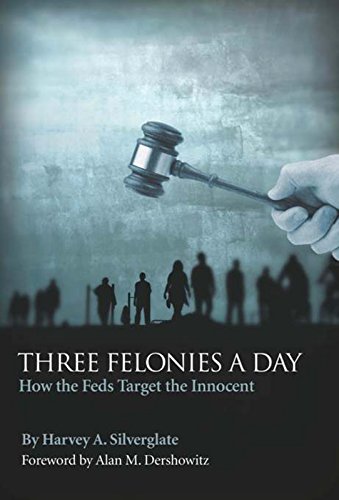
Three Felonies a Day: How the Feds Target the Innocent. By Harvey A. Silverglate, Encounter Books, 2009, 306 pages.
For the past seven years, I have written a number of articles about the growing power of federal prosecutors who are able to apply vague statutes to behavior that historically has not been illegal. Along the way, I have earned a number of enemies and detractors, and even some of my friends have been incredulous, especially when I questioned the conviction of Ken Lay.
One of my mentors in this legal and political journey has been the well-known and principled attorney, Harvey A. Silverglate, one of the founders of the Foundation for Individual Rights in Education or The FIRE, and a co-author of The Shadow University. Silverglate not only has tirelessly challenged one injustice after another, representing unpopular clients, but he also has tirelessly answered one email after another from me, as I sought legal guidance in making my own personal statements.
Finally, Harvey himself has come up with what I believe to be the authoritative book on federal criminal law, Three Felonies a Day: How the Feds Target the Innocent. If you want to understand the federal assault on the law and upon our rights, read this book, for it will provide an education for those who believe that federal prosecutors have long been overstepping their constitutional boundaries and are railroading thousands of innocent people into prison.
 Three Felonies a Day: ...
Best Price: $10.99
Buy New $32.95
(as of 04:35 UTC - Details)
Three Felonies a Day: ...
Best Price: $10.99
Buy New $32.95
(as of 04:35 UTC - Details)

This is more, much more, than a book full of anecdotes, although the anecdotes themselves tell a depressingly familiar story of the decline of law in the United States. This book also lays out the chilling facts of how the federal system of what Candice E. Jackson and I have called "derivative crimes" is patterned not after anything that Americans inherited from Great Britain and its great body of common law, but from the former Soviet Union.
That is correct. Federal criminal law closely mirrors the Soviet code and its "crimes of analogy." Silverglate writes that under the old Soviet law, "any citizen was in constant danger of being prosecuted for virtually any action if it could be analogized to or derived from something in the criminal code" (emphasis his). As Lavrentiy Beria, Stalin’s head of the dreaded secret police said proudly, "Show me the man and I’ll find you the crime."
Most readers will stop here and wonder if Silverglate is engaging in Red-baiting or using hyperbole to make a point. I wish that were true. I wish that typical federal prosecutors did not have the power simply to target individuals and then look for a "crime" for which to pursue, but that is exactly what now exists within the federal criminal system. Yet, this chilling passage taken from a 2007 article in Slate lays out the system in its full ugliness:
At the federal prosecutor’s office in the Southern District of New York, the staff, over beer and pretzels, used to play a darkly humorous game. Junior and senior prosecutors would sit around, and someone would name a random celebrity — say, Mother Theresa or John Lennon.
It would then be up to the junior prosecutors to figure out a plausible crime for which to indict him or her. The crimes were not usually rape, murder, or other crimes you’d see on Law & Order but rather the incredibly broad yet obscure crimes that populate the U.S. Code like a kind of jurisprudential minefield: Crimes like “false statements” (a felony, up to five years), “obstructing the mails” (five years), or “false pretenses on the high seas” (also five years). The trick and the skill lay in finding the more obscure offenses that fit the character of the celebrity and carried the toughest sentences. The result, however, was inevitable: “prison time.”
 CONSTITUTION IN EXILE,...
Best Price: $0.10
Buy New $3.93
(as of 04:40 UTC - Details)
CONSTITUTION IN EXILE,...
Best Price: $0.10
Buy New $3.93
(as of 04:40 UTC - Details)
One asks how this can be, how a Mother Teresa or anyone else who clearly lives an exemplary or at least law-abiding life can be targeted, tried and convicted as a felon. The reason is that federal prosecutors have a stunning arsenal of weapons given to them by a Congress that no longer cares about law and courts that are all-too-happy to concentrate vast power into the hands of federal prosecutors who are busy trying to satisfy conviction and property-seizure quotas.
The key to understanding prosecutorial weapons is to understand how the various fraud and conspiracy statutes are applied. Prosecutors are able to take even legal acts and hammer them into "fraud, conspiracy, and money laundering," each of which carry severe penalties and make it nearly impossible for someone who is targeted to escape.
An extreme example is the prosecution of the late Ken Lay, who was the CEO of Enron, which failed spectacularly in 2001. As Silverglate points out, federal authorities were able first to move "up the ladder" by going after lower-level executives and employees and threatening to charge them with crimes unless they agreed to testify against higher-ups. The testimony that the government instructed these people to give, as Silverglate points out, often was not true, but it was useful to prosecutors, who were seeking indictments and convictions against people who had become unpopular.
To understand the case against Enron and other corporations in which executives went to prison, first one must understand that the nebulous "fraud" statutes under which they were convicted can be enacted even if the executives did not break a single law. For example, the infamous off-loading of Enron’s non-earning assets into "special purpose entities" resulted in "securities fraud" convictions, yet the presence of the SPEs was not hidden, but rather was included in Enron’s financial statements at the instructions of the auditor. Silverglate asks: "Is it fraud when questionable accounting practices, approved by an auditor, are hidden in full view?"
When Lay was convicted of "securities fraud" for selling Enron stock (while also buying shares of the same), the media portrayed it as a case of the CEO "quietly dumping his stock" while urging others to buy it. However, when Lay sold that stock, he did so to raise cash to cover margin calls for other investments, and before he sold anything, he sought the advice of an attorney in order to determine how he legally could do so.
Yet, prosecutors were able to lump these actions — all legal by themselves — into "securities fraud" and have a judge and jury, not to mention the general public and the supposed "watchdog" press, buy into it. Like the hapless Soviet citizen who averaged committing three felonies daily, even when Enron executives were trying to obey the law, they still were "breaking" it.
This is not a defense of Enron itself or the complex mathematical models that the company used to wow the investors of Wall Street. Nonetheless, the Enron prosecutions came about because the company failed, not because of any real criminality. For that matter, if Ken Lay and Jeffrey Skilling were convicted of "fraud" because of SPEs, then why are members of Congress and the administration not prosecuted for putting huge unfunded liabilities carried by taxpayers "off-budget"? Both Fannie Mae and Freddie Mac were engaged in actions that dwarfed any alleged wrongdoing at Enron, yet even though the financial damage caused by these mortgage giants was far greater than anything that came from Enron’s fall, nonetheless Fannie Mae executives like Jamie Gorelick and Franklin Raines were able to walk away from Fannie with millions of dollars in their pockets and have no worries at all about being hauled into criminal court. They had political connections — the right kind of connections — and that was all that was needed.
Thus, we see prosecutions that not only are selective — channeling Beria — but federal law itself also permits prosecutors to fashion acts that are legal into crimes that carry serious time. Furthermore, prosecutors can take one action and then pile multiple acts upon it. For example, when jurors declared Lay guilty of "fraud," they also convicted him of "money laundering, "wire fraud," and other such acts that by themselves carry draconian prison penalties.
 What makes these other "crimes" so insidious is that they cannot be instituted without an underlying act, which means they cannot stand alone. If I mail a letter with a fraudulent tax return, then not only am I guilty of "tax evasion," but I also can be charged with "mail fraud" for the simple act of mailing a letter. If I put some of my alleged ill-gotten gains in a bank, or purchase any goods with that money, I have committed "money laundering," for which the penalty is a maximum of 20 years in prison.
The combination of these "crimes" gives prosecutors enormous leverage against defendants, for if they choose to go to trial and falter on just one criminal count, they are sent to prison for many years. Thus, many people — even people who maintain their innocence — will plead to something because the alternative is much worse.
As Silverglate says, that is not justice; it is tyranny. He writes:
If I am right, we must foster the realization that the Justice Department’s tactics too often are employed not to protect, but to attack law-abiding society (emphasis mine). While it is true…that sometimes creative criminal "miscreats" cleverly get around the letter of the law (especially laws that have become obsolete) and therefore tempt equally creative prosecutors to stretch the law, it is also true that too many ordinary, well-meaning, and innocent people get caught in the maw of the Department of Justice’s prosecutorial machinery. For them, life becomes nightmarish, like an episode in a Franz Kafka novel.
I realize this book will not convince everyone of the peril we face at the hands of rapacious federal prosecutors. Federal jurors, like nearly everyone else, seem to defer to the very worst prosecutors as though they were giving an Edict from the Gods. The press is of no help, as reporters seem to enjoy the "perp walks" and every other trapping that comes from covering federal criminal cases.
Three Felonies a Day: ...
Best Price: $10.99
Buy New $32.95
(as of 04:35 UTC - Details)
In the Martha Stewart case, the press was much more interested in what Stewart wore to her trial than to the nature of the charges against her. It mattered not a whit to the press that federal prosecutors had illegally leaked grand jury information in order to trick Stewart into meeting with them so they could charge her with lying. Certainly, no one in the numerous U.S. law schools is trying to deal with this problem, and forget Congress.
To put it another way, when the U.S. Government embraces the law of the Soviet Union, then the law is lost. Federal criminal law cannot be salvaged or rewritten to restore even a modicum of the "rule of law." Yet, unless that is what is done, federal prosecutors will continue to wrongfully charge and prosecute individuals who are innocent, juries will convict them, judges will send them to prison, and the New York Times will continue to tell us how lucky we are that federal prosecutors are on the job.
The Best of William L. Anderson
 McNamara's Evil Lives On